Wildest Dreams


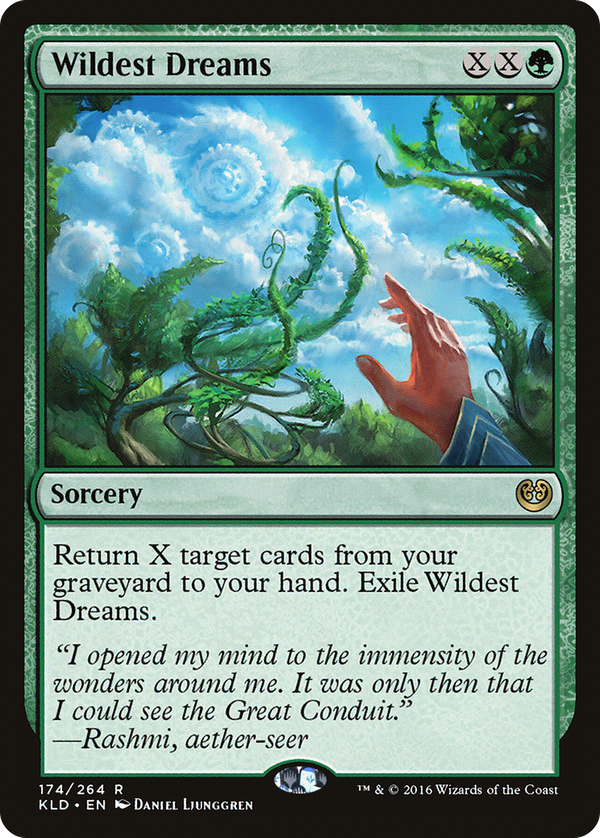
The cost is the whole argument, and it is a deliberate brake. Most mass-recursion in green is flat-rate (Eternal Witness buys one card per body, Den Protector taxes you a creature slot per loop), so a spell that scales freely with mana looks like a tax dodge until you notify the actual math: returning four cards costs nine mana, and you only get the spell once before it exiles itself. That self-exile clause is the second brake, and the more interesting one. Bulk graveyard recursion is usually balanced by being slow or narrow; this one is balanced by being a single shot. There is no flashback, no recursion of the recursion, no engine to assemble. You pay a swelling sum, you reload your hand from the yard, and the card permanently leaves the game. It reads as a green Regrowth scaled up for the late game, but the design is really about a single decisive refill: the turn you are flooding on land and want to convert it into a fistful of spells, or the turn after a board wipe when you need to rebuild the hand that produced the board. The diminishing-returns shape (each extra card costs two more mana, not one) keeps it from ever being the cheap two-for-one that defines green's value baseline. It is a finisher for attrition, priced so it only arrives when the game has already gone long.