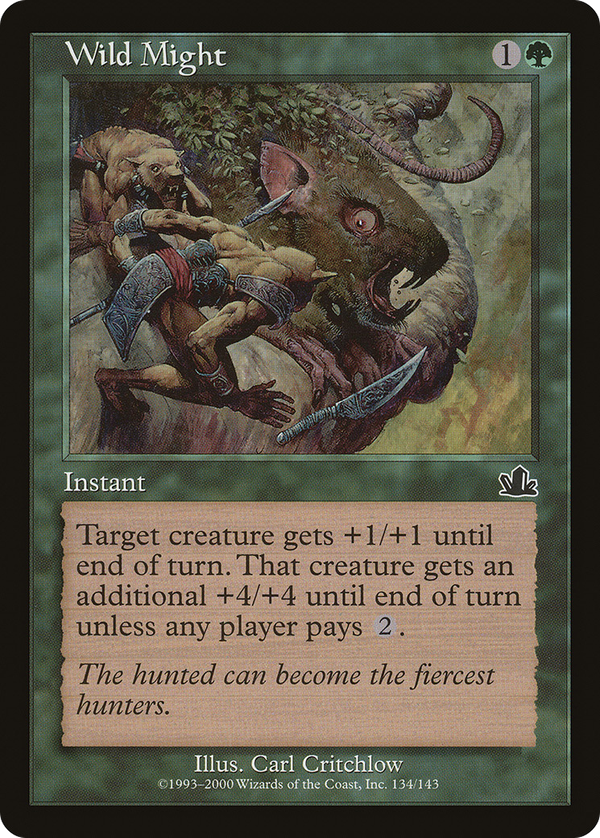
Wild Might


The whole card is built around a single tax: a substantial burst of power that any player can decline, but only by spending two mana of their own at exactly the moment the spell resolves. The guaranteed +1/+1 is almost a formality; the +4/+4 is the real payload, and the design hangs its entire tension on whether anyone can afford the toll right then. This is an early-era "rhystic" pattern, where designers experimented with effects that resolve fully unless an opponent pays a fee, applied here to a combat trick. The interesting wrinkle is that the spell does no work to extract the decision: by the time it is on the stack and resolving, the choice to pay is forced and immediate. All the real maneuvering happens earlier, in the defender's head, before you have committed to anything. A blocker who wants the option to neuter the trick has to be holding two open mana on the speculation that you cast it, because the toll cannot be paid retroactively and there is no second window. Against an opponent who tapped out, the +4/+4 is simply yours and the block is a disaster. Against one sitting on two untapped lands, the big payoff evaporates the instant the spell resolves and you are left with a two-mana +1/+1. The rhystic frame never became a fixture the way kicker or buyback did, and the rate here is part of the reason: a trick whose ceiling lives entirely in your opponent's mana count is a blowout when it lands and an embarrassment when it does not.
Rules text
 .
.