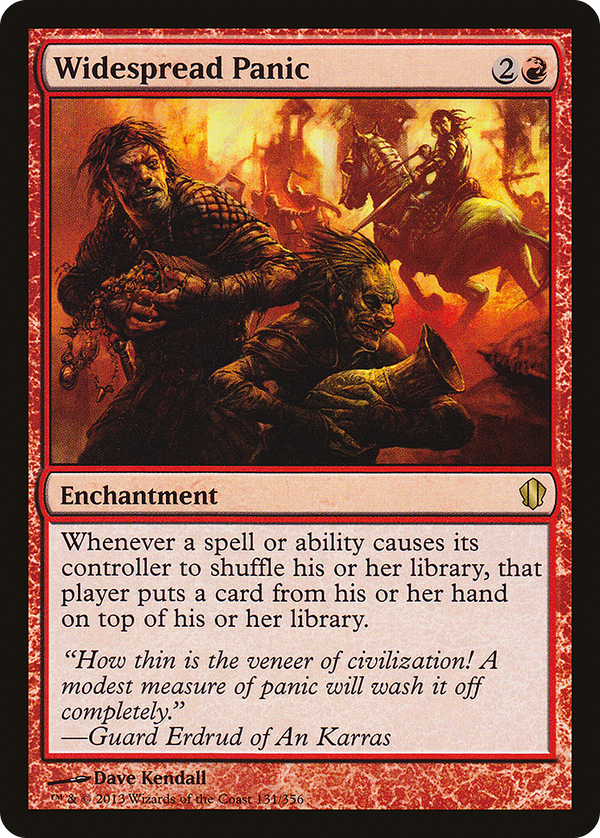
Widespread Panic


Shuffling a library is the most invisible cost in the game: fetch lands, tutors, scry-then-shuffle effects, and library manipulation of every stripe treat the shuffle as a footnote, a bookkeeping step the opponent never thinks twice about. This taxes that step. Every shuffle the table triggers forces the shuffling player to commit a card from hand to the top of their library, which sounds like nothing until you trace what it actually punishes. The tutor that found the perfect answer now has to bury a hand card to do it. The fetch land that was supposed to fix mana costs the player a card of their own choosing, locked onto the top before they ever draw. It is a group hug card inverted into a group tax, an enchantment that does nothing to the board and everything to the search-heavy decks that lean on shuffling as a resource. The asymmetry is the appeal: a deck built to ignore shuffle effects sits comfortably while the tutor-and-fetch decks around it pay a quiet toll on every search. It rewards a controller who has built around disrupting other players' draws rather than one hoping for chaos, and it sharpens against exactly the powerful, tutor-dense strategies that treat finding the right card as a solved problem. Where an opponent shuffles four times a turn, this rewrites how that engine functions; where nobody shuffles at all, it sits inert, a card whose value scales entirely with the greed at the table.