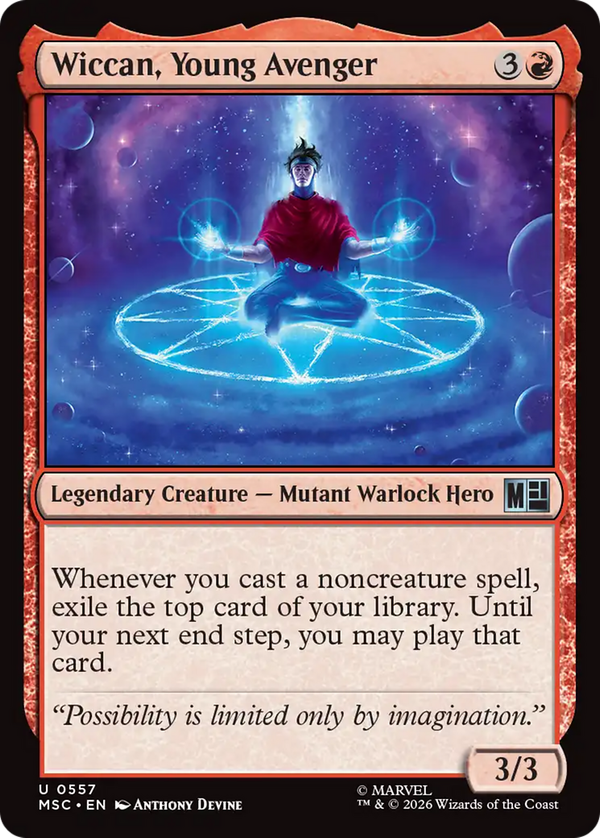
Wiccan, Young Avenger


Most impulse-draw designs charge you at the front: you pay extra to dig past your next draw. This flips the accounting to the back end. Each noncreature spell you commit to the stack peels a card into a temporary hand, so cheap cantrips, burn, and rituals all feed the same loop as long as they carry the right type. The payout keys on cast, not resolution, which is the crucial detail: even a countered or fizzled spell still churns the deck, so you get paid for the act of casting rather than the result. The body is nearly incidental; this is a spellslinger valve rewarding the lowest-cost noncreature spells you can pack, since each cast buys another look. The exile window does the shaping work. A card revealed on your main phase survives only until your next end step, so you either spend it this turn or watch it evaporate: the design punishes hoarding and rewards a tight, chained sequence, one spell fueling the next. It belongs to red's tradition of card advantage that trades permanence for tempo, closer in spirit to Light Up the Stage or Bedlam Reveler than to any blue draw spell, but built as a repeating faucet rather than a single burst of refill. The tension is between velocity and waste: play too slow and the engine leaks value; play fast and it becomes a self-accelerating chain that outruns your own hand.