Whetstone

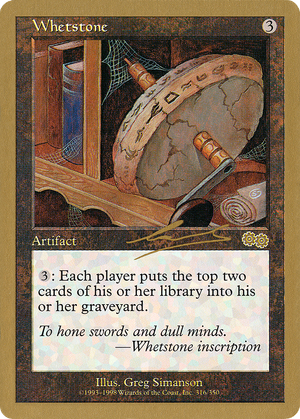
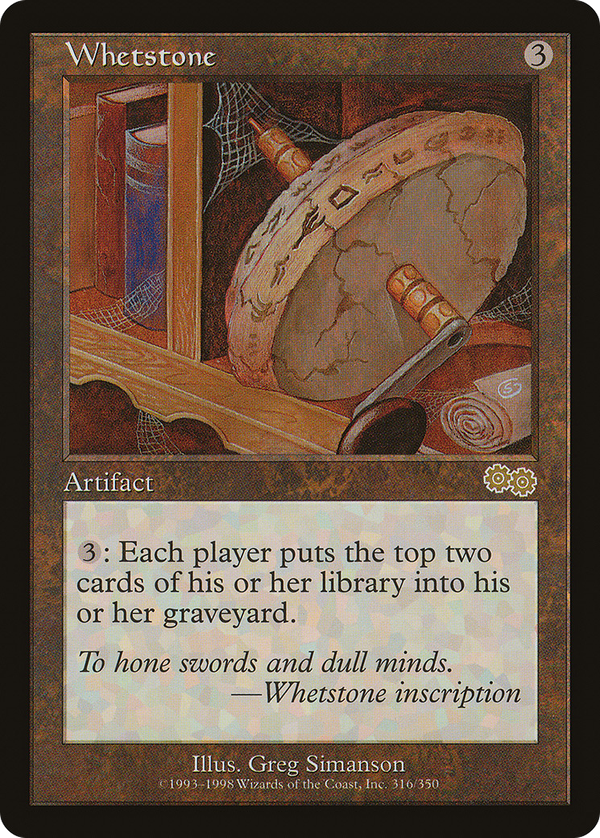
The most honest thing about this design is its symmetry, and the second most honest is how badly that symmetry breaks the strategy it serves. Pay three mana, both players lose two cards from the top of their libraries: a repeatable, colorless engine for emptying a deck. The problem is arithmetic. Three mana per activation grinds away four cards total, but the player using it spends a turn doing nothing else while feeding two cards into their own graveyard for every two they remove from the opponent's. A mill plan wants the disparity working in one direction; this one charges you the same toll you levy. The friction that balances the rate is precisely what relegates it to the sidelines: in a true mill strategy you want asymmetry, and in a symmetric race you have just built your opponent a clock against yourself. Where it earns a second look is in decks that have already inverted the math, the graveyard-as-resource builds that treat their own milled cards as fuel rather than loss. There the symmetry becomes a feature: a colorless way to load a yard for both players, with the opponent's half as incidental damage or incidental gift. Its oracle text reads far simpler than the deckbuilding question it poses, which is less "how do I mill them" and more "do I actually want to mill myself this many times to do it."
Rules text
: Each player mills two cards.