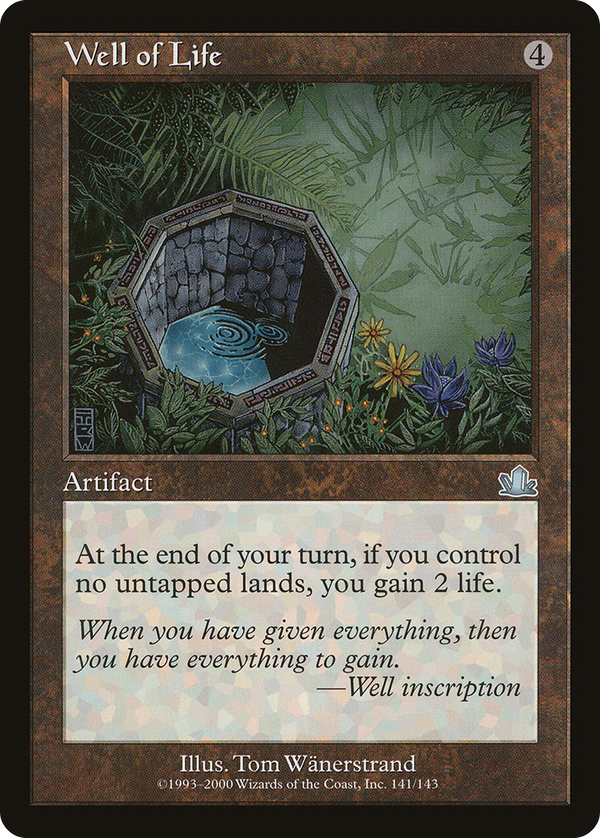
Well of Life

The era that produced this artifact built an entire mechanic around the idea that tapping out your lands should be a resource, and this is the payoff valve for that gamble. The trigger only fires if you end the turn with no untapped lands, which is the opposite of how almost every other card wants you to sequence: it rewards spending every point of mana you have, leaving nothing held back for an instant or a blocker. Two life is the entire ceiling, and it is a slow drip rather than a swing, so the card never threatens to do more than buy time for a deck already committed to emptying its hands and lands every turn. The friction is self-imposed and absolute: hold one land open for a counterspell or an end-step play and the well goes dry that turn. This is a design experiment in turning the act of tapping out (normally a vulnerability) into a recurring trickle of value, a conditional engine that only a deck structured around full commitment could ever switch on. Outside that narrow build the condition almost never aligns, which is why the effect reads as marginal: the lifegain is real, but the price is playing the entire game in a posture most decks spend their mana avoiding.