Weaver of Lies


Morph was the era's signature mechanic, a way to drop any creature as a featureless 2/2 with a hidden flip cost, and someone at the design table asked the obvious follow-up: what preys on the flip step itself? The answer is a trigger that re-hides morphs. When this turns face up, it can flip any number of face-up morph creatures (anything except itself) back down. That self-exemption is the whole hinge, because the trigger only reaches creatures that already have morph in their text, and a face-down creature has no abilities at all: it cannot be targeted by this. So the resets land on morphs that have been unmasked. Each morph carries a one-time turn-face-up trigger, and most of the strong ones (the removal flips, the engine flips, the bounce flips) only pay out once; resetting your own already-flipped morphs recharges those triggers so their entry effects fire a second time. Pointed across the table, the same clause is tempo denial: a morph the opponent has unmasked and paid full cost to deploy gets reset to a 2/2 with its identity now public, and they have to pay the morph cost again to recover it. The price of admission is steep. The plan is gated behind getting this face up, which means  to deploy it and
  to unmorph, eight mana across two turns before a single creature flips. As mechanic-specific technology it is narrow by design, but it is not dead in a morph-light game so long as you have your own face-up morphs to recycle.
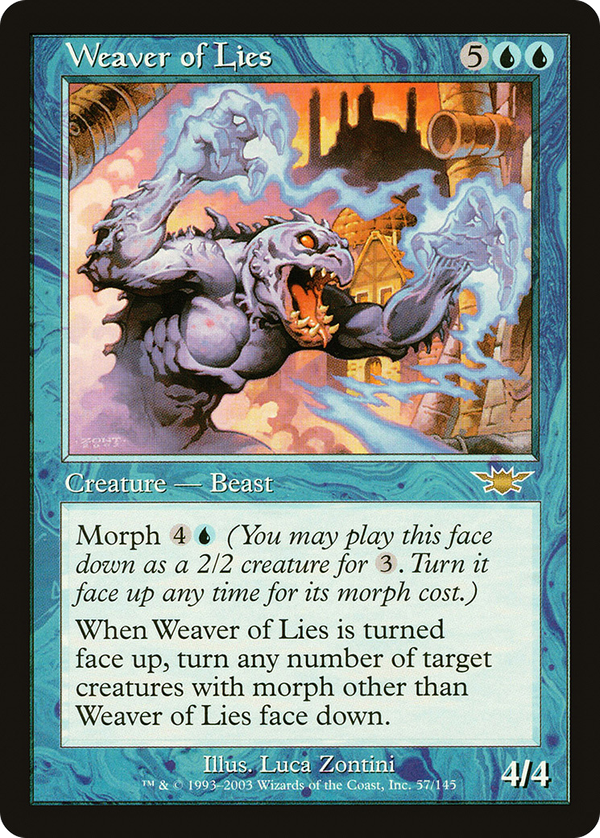
Rules text
(You may cast this card face down as a 2/2 creature for . Turn it face up any time for its morph cost.)
When this creature is turned face up, turn any number of target creatures with morph abilities other than this creature face down.