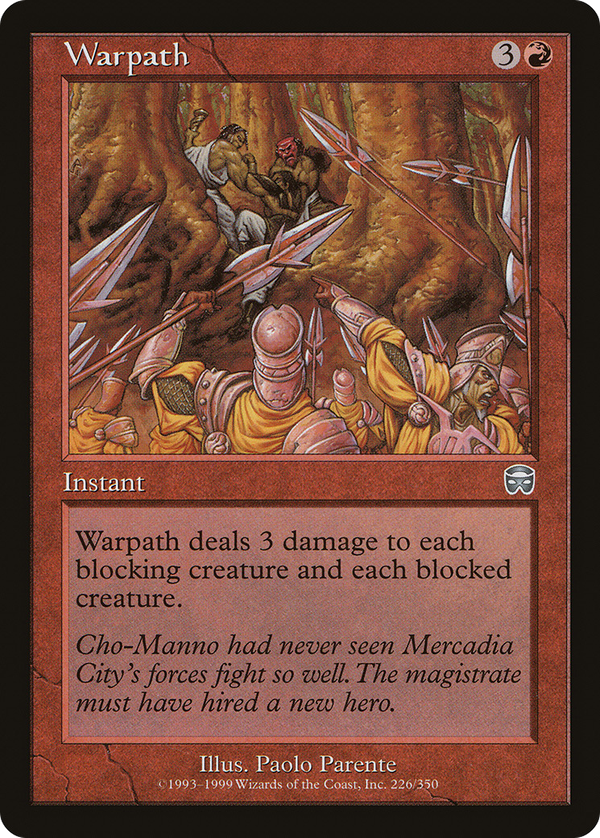
Warpath


The genius here is the conditional: this only hits creatures already committed to combat, which means it does nothing the moment it resolves unless an attack is already underway. That restriction is what lets it scale so violently. Cast it after blocks are declared and it can wipe an entire combat step, the attacker's swing and the defender's wall both, for a single red splash. The card rewards the player who controls the timing of the fight rather than the player with the bigger board: bait a gang-block on one of your creatures, then resolve this in response and watch the defender's investment evaporate alongside your bait. It is a punish for over-committing to combat math, and it reads the battlefield the way a sweeper reads a board, but priced and scoped to a single combat phase rather than the whole game. The asymmetry only appears when you build for it; cast blindly it is just as likely to cost you as your opponent, since every creature tangled in that combat takes the same 3. That symmetry is the cost of the rate, and it is the difference between a deck that uses this as a one-sided blowout and one that hands the opponent a free two-for-one.