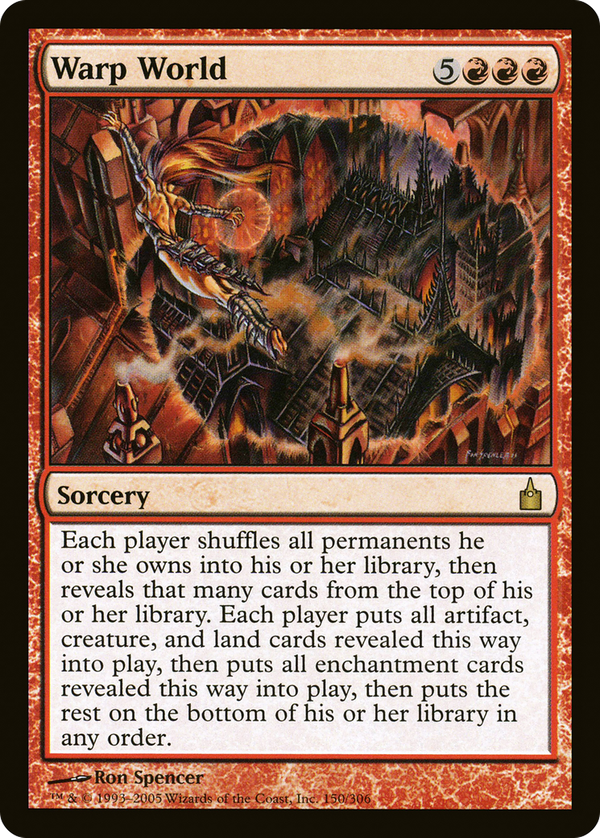
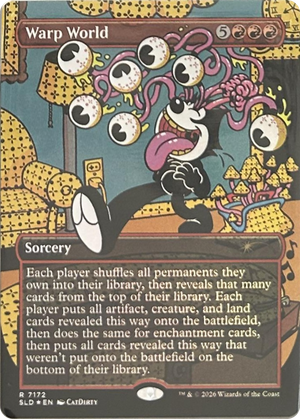
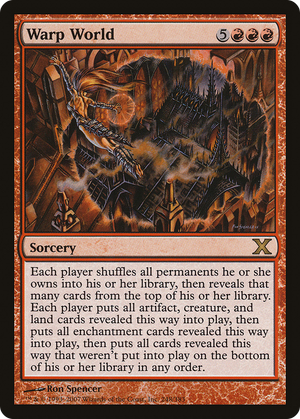
Warp World


Total reset: not the board but the entire permanent layer of the game, redrawn from the deck. Every permanent gets shuffled back in, then each player reveals as many cards as they just buried and slams the qualifying ones straight onto the battlefield. The conservation law buried in the wording is the whole design: you reveal exactly as many cards as you had permanents, so the player who committed the widest board both loses the most and reseeds the most. It is variance weaponized into a plan. Note what the shuffle does and does not do. Because permanents return to the deck instead of dying, indestructibility never matters, nothing is sacrificed, and death triggers and sacrifice payoffs sit silent. The two-step resolution (artifacts, creatures, and lands first, then enchantments) is precise layering for a reason: any aura or enchantment payoff needs something already on the battlefield before it tries to attach. A deck built around this does not plan its post-cast board so much as stack the odds, packing the library with permanents so the reveal blossoms into chaos rather than collapsing into a fistful of bottomed spells. Red has plenty of effects that wreck the board; few that wreck and re-roll in the same breath, putting permanents directly into play off the top of every library at once. Who benefits is never decided on the cast but by the cards underneath, the reason it has stayed a kitchen-table engine and never a tournament fixture.