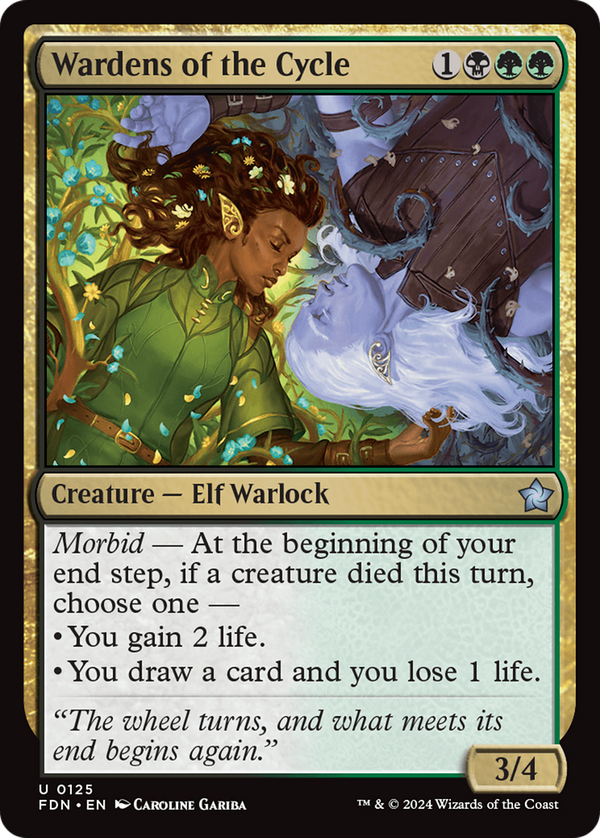
Wardens of the Cycle



The morbid trigger here does something quietly clever with the sacrifice-payoff formula. Most aristocrats engines lock you into one axis: either you drain the table or you refill your hand, and the ratio is fixed at printing. This one hands the choice back to you each of your end steps, contingent on the same single-death condition. The life-gain mode stabilizes when you are on the back foot; the draw mode presses your advantage when you are ahead, and the one life it costs is a rounding error in a deck already trafficking in creature deaths. Because the trigger only checks that a creature died this turn (any creature, yours or an opponent's, once is enough), the 3/4 does not have to feed itself: any combat trade or removal spell in the game satisfies the condition. That decouples the payoff from the fodder, which is the real design efficiency: a durable blocker that turns every death into a resource asks very little to earn its keep. The tension a fixed-mode drain-or-draw creature usually carries, where you wish it were the other half, gets resolved by simply not committing until the end step tells you which half you need. It sits in the lineage of black-green value creatures that reward a graveyard filling up under its own momentum, but the modal end-step choice is the wrinkle that keeps it relevant deeper into a long game than a static trigger would.