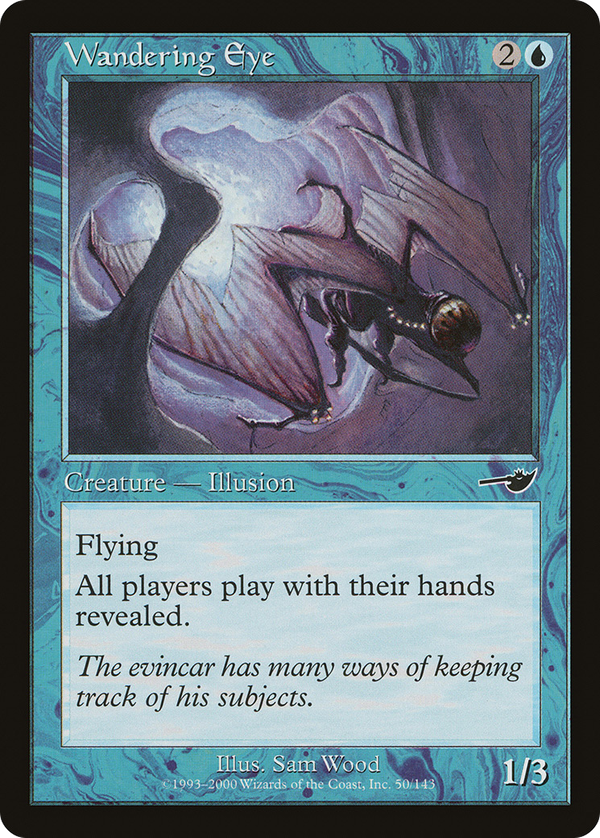
Wandering Eye


Symmetry is the gimmick, and it cuts harder in some games than others. By revealing every hand, including its controller's, the design wears the mask of fairness: nobody hides anything. But the value of hidden information is rarely symmetric. A control deck that reads its opponent's hand can sequence around it; a combo or trick-based deck that loses the surprise of an unseen response loses its whole edge. The 1/3 body is built to outlast the early game rather than dominate it: a flier that survives the small ground beaters and patrols the air, parking a passive disruption effect on the board instead of committing to a single answer. What separates this from a momentary glimpse is permanence. A single-target reveal tells you what is in a hand right now; this keeps the hand open every turn, every draw, until the creature dies. That turns the opponent's choices into a slow leak: they cannot bluff, cannot represent a counterspell they do not hold, cannot threaten a trick that is sitting face-up on the table. Among the permanents that turn open information into a weapon against decks built on concealment, this one carries an honest tax: its own controller plays with cards exposed too, so the lock is never quite one-sided.