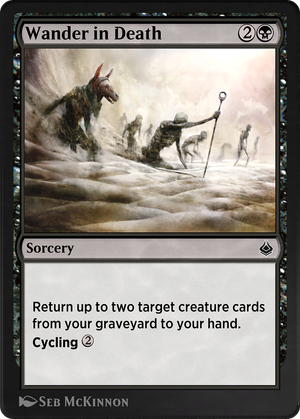
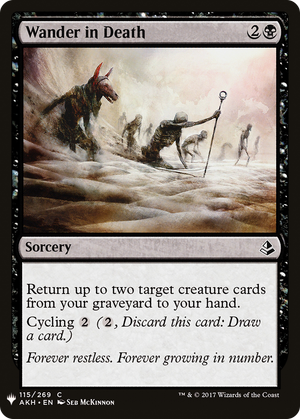
Wander in Death


Recursion that hedges its own bet. Returning two creatures from the graveyard is a respectable bit of card advantage, but the rate has never been quite enough to want at sorcery speed when your graveyard is empty or your hand is already crowded. Cycling answers that dead-card problem: when the recursion is irrelevant, the card sheds itself for a fresh draw, so the slot it occupies never sits idle. That is the bargain of the cycling-onto-a-spell design black leaned into in this era: a card you would not always cast becomes one you never regret drawing, because the worst-case still replaces itself. The two-target reach back into the bin pairs naturally with creatures that carry value on entry or value on the way out, so pulling two bodies is really pulling two enters-the-battlefield triggers or two future sacrifices: a refuel for decks that have spent their early creatures and want them again. The cycling cost also smooths a deck whose graveyard plan has not come together yet, trading a stranded recursion spell for whatever the top of the library offers. Nothing here is flashy; the design is doing the unglamorous work of giving a single card two distinct jobs, one for the long game and one for the turns before the long game arrives.
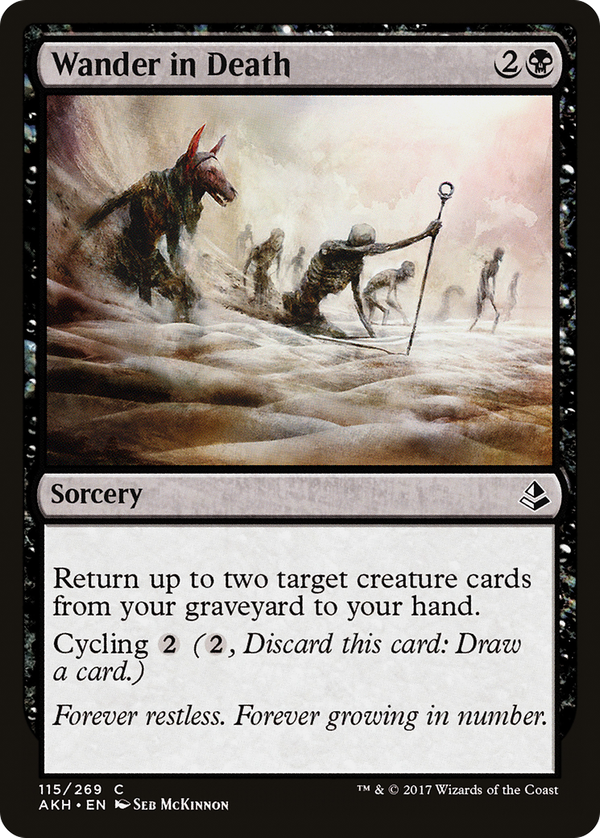
Rules text
(, Discard this card: Draw a card.)