Wand of Ith

A discard spell that taxes the opponent for keeping their cards: that is the design pitch buried in this clunky artifact, and it explains why nothing quite like it survived into the modern game. The randomness is the whole problem. You do not get to strip the threat you fear; you reveal a card at random and let the opponent buy it back, paying a life toll scaled to how much it would cost them to cast it. A land asks for one life or hits the bin; a fatty asks for a chunk of life proportional to its mana value. The math almost works on paper as a slow life-drain engine, but the activation is gated three ways: three mana plus the tap on top of the four-mana cost to deploy it, and the clause that locks the ability to your own turn so the opponent can never be caught with a single card in hand at end of turn. Early design was fond of these probabilistic taxes (the era treated "reveal at random" as a clean way to launder a hand-attack effect through chance), but the approach faded once it became clear that randomized disruption asks the controlling player to do work without controlling the outcome. It is a museum piece of how mid-nineties design thought about hand denial: punitive in theory, too slow and too random to ever bite.
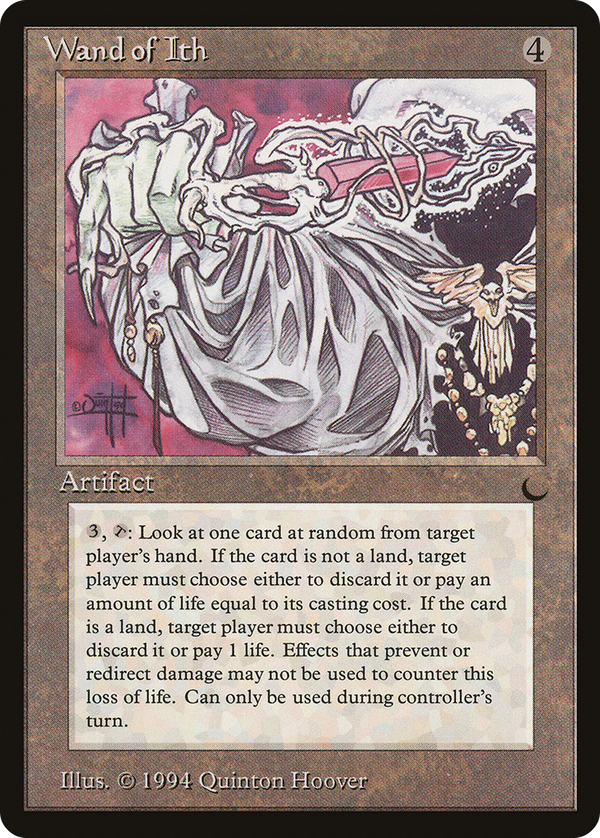
Rules text
 ,
,  : Target player reveals a card at random from their hand. If it's a land card, that player discards it unless they pay 1 life. If it isn't a land card, the player discards it unless they pay life equal to its mana value. Activate only during your turn.