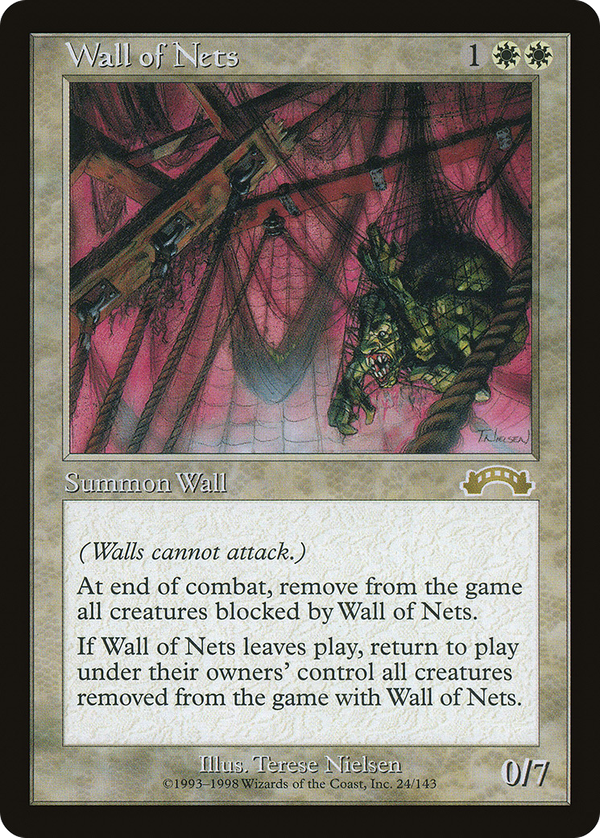
Wall of Nets


A 0/7 body that doesn't just stop attackers but deletes them: any creature it blocks gets exiled at end of combat, an answer dressed up as a blocker. The design's whole tension lives in the leaves-the-battlefield clause. Everything Wall of Nets has eaten comes back when the wall leaves the battlefield, which turns the exiled pile into a hostage situation that runs in reverse. Kill the wall and your opponent reclaims a board's worth of creatures all at once, under their owners' control; the longer the wall survives the more it has swallowed and the worse its departure becomes for the controller. That makes the card a liability the moment it stops being an asset, and it rewards an opponent for biding time rather than committing to crack through it. The structural discipline is elegant: removal that doesn't permanently remove, paired with a body that begs to be removed. It also rewrites combat math in a way few defensive cards do, because attacking into it is not a tempo trade but a permanent loss until the wall falls. The result is a blocker that interrogates the attacker more than it stops them: do you have a way to break the exile, or are you feeding a creature into the void on the gamble that you can topple a 0/7 later? That conditional ownership of exiled cards, returning to owners rather than the wall's controller, is the constraint that keeps the effect from being simply a one-sided removal engine.