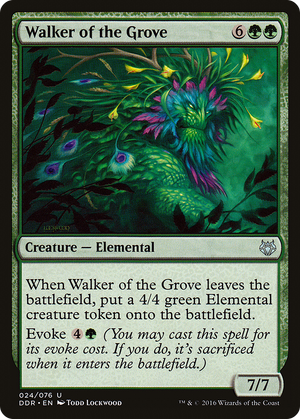
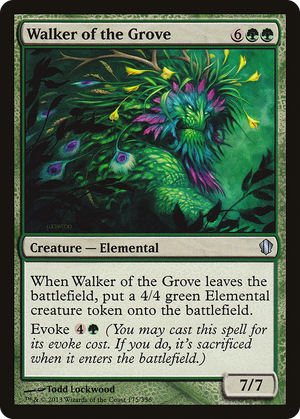
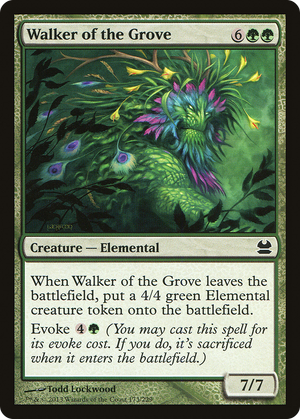
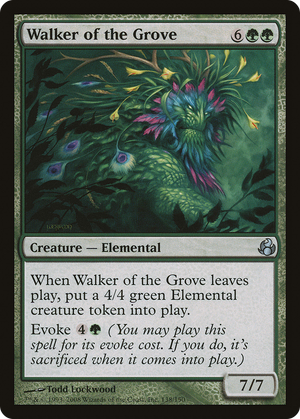
Walker of the Grove


Evoke is usually a contract you sign to lose value gracefully: pay less, get the enters-the-battlefield trigger, hand the creature back to the void. This one inverts the math. Because the body's payoff fires when it leaves the battlefield rather than when it arrives, the evoke sacrifice is not a tax on casting cheap; it is the trigger itself. Pay the reduced cost, the Elemental hits play, then immediately dies and leaves a 4/4 behind. You spent less mana and still came out ahead on board, just spread across a different body. Hardcast at the full eight, you get a 7/7 that promises a 4/4 successor whenever it dies, so removal and chump-blocks never trade cleanly against it. The design reads as a deliberate answer to evoke's central problem: most evoke creatures feel bad to hardcast because the full price buys a fragile body for a one-shot effect, and bad to evoke because you are torching a creature you paid for. By moving the value to the leaves-the-battlefield window, both modes pay off, and the choice becomes a genuine question of tempo (4/4 now for less) versus ceiling (7/7 plus a 4/4 later). A single timing word, "leaves" instead of "enters," flips the keyword's entire risk profile, and this card is the clearest demonstration of how much that swap can change.
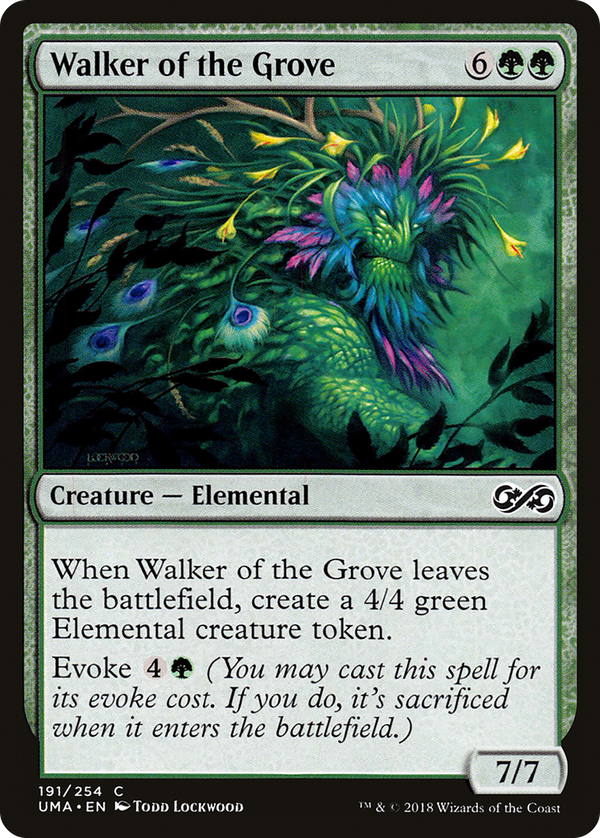
Rules text
 (You may cast this spell for its evoke cost. If you do, it's sacrificed when it enters.)