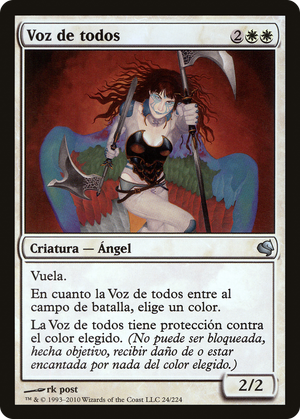
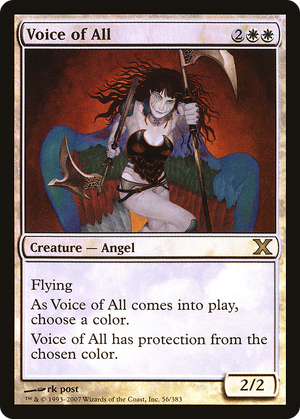
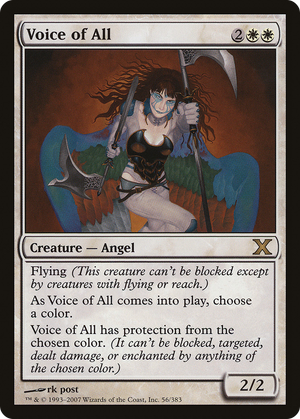
Voice of All


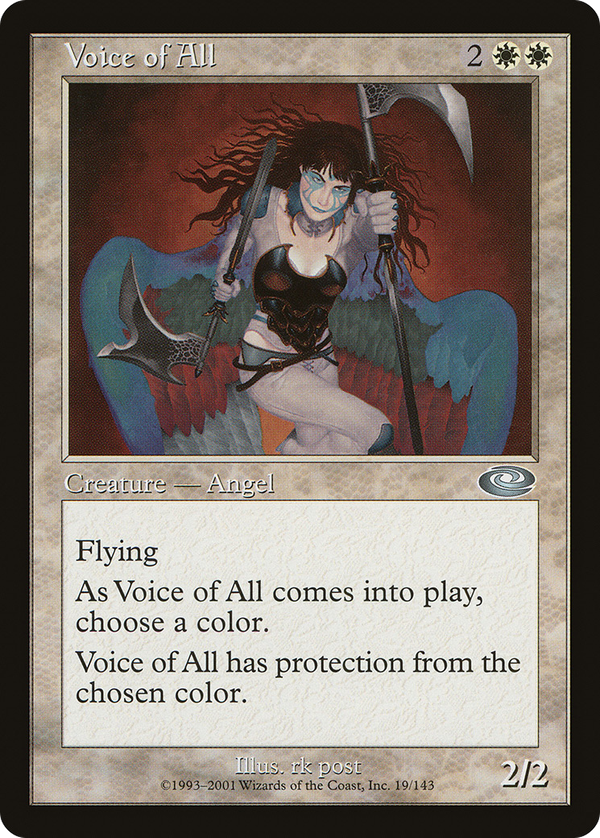
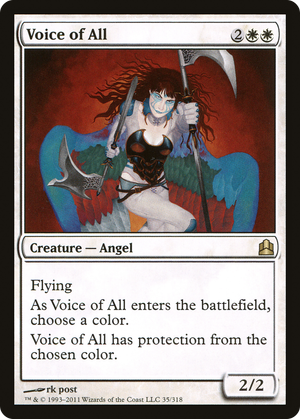
Protection used to be a fixed printing decision: Paladin en-Vec gave you red and black whether you wanted them or not, and you took the keyword that came stapled to the card. The innovation here is handing that choice to the player at resolution. Naming a color as the Angel enters means the same body answers whatever threat is actually in front of you: protection from red to walk past burn and block fire-breathers, protection from white to dodge a mirror's removal and shrug off white blockers in combat, protection from green to neutralize the fattest creature an opponent can muster. The flying stacks evasion on top of the chosen color, turning a body that a single color would otherwise handle into a clock that color cannot interact with through normal channels. The cost of all that flexibility is paid in the stat line, a 2/2 that asks to be read as a problem-solver rather than a beater, and in the timing: you commit to one color as the creature enters, so the answer locks before you know what the next several turns hold. That tension, a flexible choice that hardens into a fixed one the instant you make it, is the real design lesson. It rewards reading the board a beat ahead and punishes naming a color out of habit.