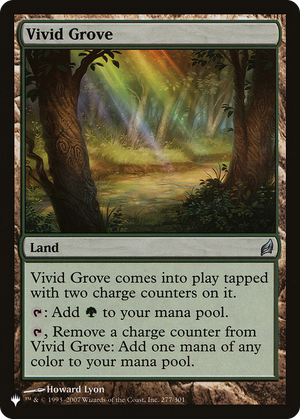
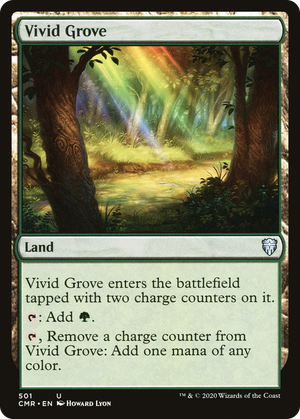
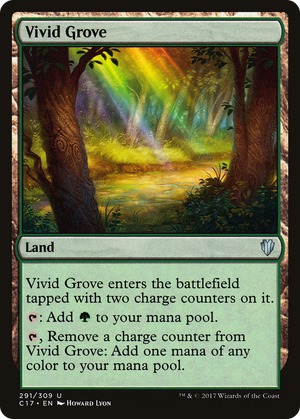
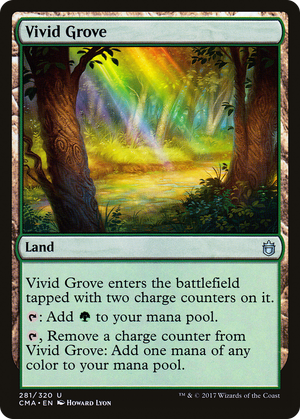
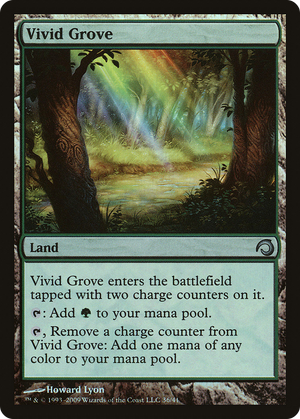
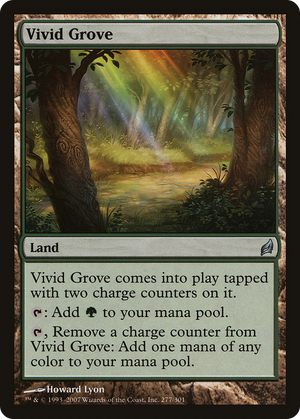
Vivid Grove
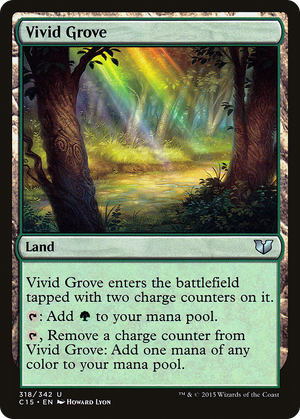
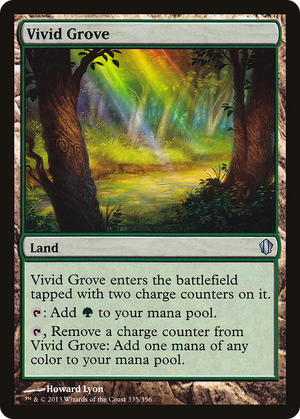
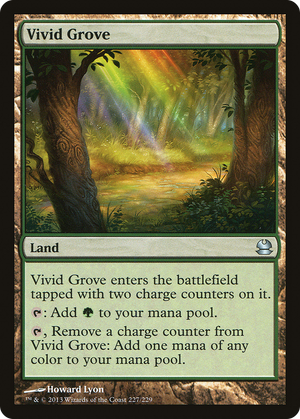
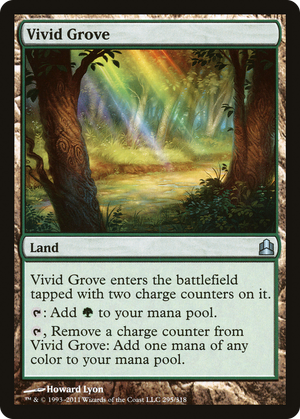
The whole pitch of the Vivid cycle was rationed flexibility: a dual-purpose land that taps for its own color all day, but holds exactly two doses of any-color fixing before reverting to a mono-color source. That counter limit is the price, and it is a genuinely different model from the painlands or the fetch-thinned duals that surround it. Where a painland charges you life every time and a fetchland charges you a card up front, this asks nothing recurring; it simply has a hard ceiling on rainbow output, after which it is a green source and nothing more. The entering-tapped clause does the rest of the bargaining, a tempo tax that keeps the cycle out of aggressive decks and pushes it toward the slower, greedier manabases that actually want to splash. Crucially, the two activations are exactly enough to cast a couple of off-color spells across a long game without ever becoming an infinite rainbow engine, which is the design discipline that kept these lands from displacing more expensive fixing entirely. Read now, the structure looks like an answer to a specific question: how do you give a five-color deck reliable color access without either the life loss of pain or the deckbuilding cost of fetching? The charge counter is the answer, and the fact that it depletes is the entire reason the land was allowed to be painless.
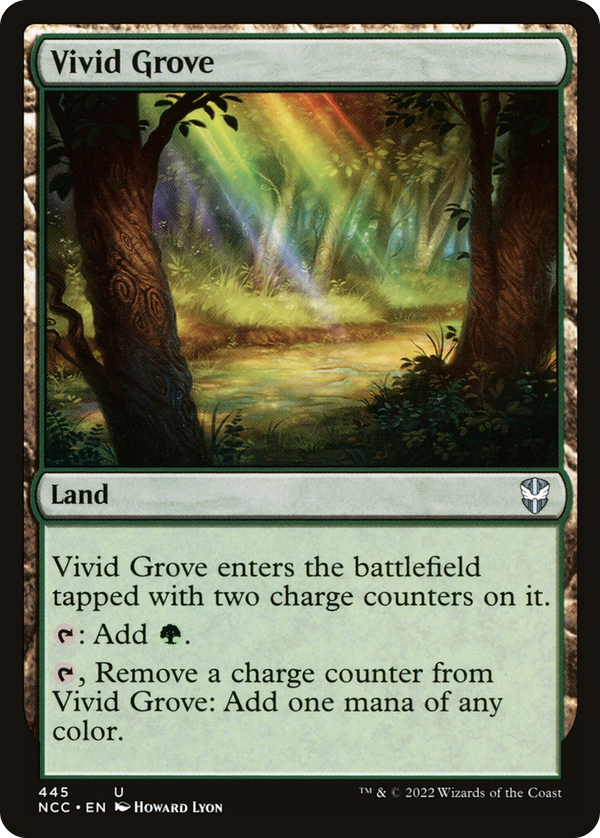
Rules text
 : Add
: Add  .
, Remove a charge counter from this land: Add one mana of any color.
.
, Remove a charge counter from this land: Add one mana of any color.Format Status
More formatsFewer formats
Other printings
- The List#LRW-277
- Commander Legends#501
- Commander 2017#291
- Commander Anthology#281
- Commander 2015#318
- Commander 2013#335
- Modern Masters#227
- Commander 2011#295