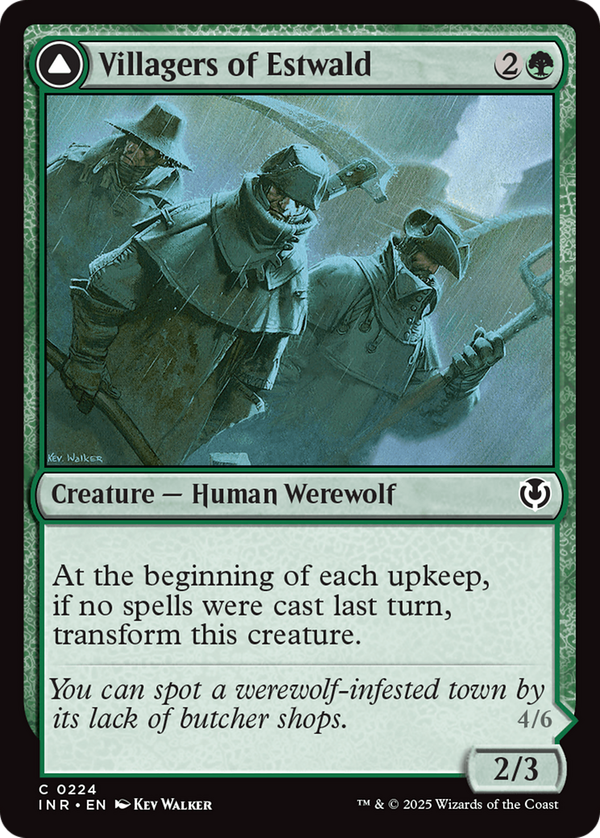
Villagers of Estwald // Howlpack of Estwald
The original werewolf template, and the one that first taught players to check the upkeep trigger before passing the turn. The two faces resolve a single design tension: how do you make a creature that punishes inactivity without making the inactivity feel like a tax? The answer here is symmetry. Sit on your spells and the 2/3 Human flips up into a meaner body; let a turn pass where someone fires off a pair of spells and the Howlpack reverts. That second clause is the underrated half, because it hands the opponent a lever. The flip is not yours to control alone, which means every werewolf board state becomes a negotiation over the stack: do you cast that extra spell to flip their pack back, or hold it and let them keep the bigger side another turn? The "if no spells were cast last turn" condition checks the whole previous turn, both players included, so a single instant in either main phase or on the opposing turn is enough to deny the transform. That global, two-sided trigger is what gives the werewolf shell its distinctive rhythm, a stop-and-start cadence where doing nothing is sometimes the strongest play. Later werewolf cycles refined the wording (daybound and nightbound eventually centralized the day/night state across the battlefield), but the structural idea, that casting spells is the currency governing the flip, starts with designs built exactly like this one.