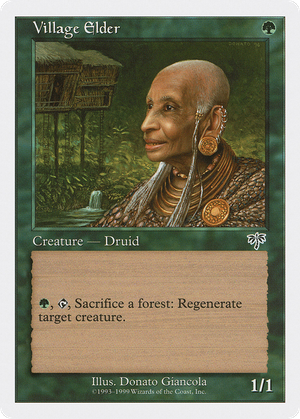
Village Elder

Regeneration on a stick, priced for a forgotten era. The design idea is the conversion of standing resources into protection: you trade a Forest already in play for the ability to make a creature unkillable in combat, repeatedly, for as long as your forests last. That is a steep cost by any modern accounting, and it reads as steeper still because regeneration itself has fallen out of favor as a keyword. But the math is the point. Each activation is a permanent commitment, not a one-shot spell, so the card is built around the slow attrition of a green-based board: a 1/1 body that quietly converts land into combat insurance turn after turn. The friction that balances it is the sacrifice clause. Regeneration without a cost would be a defensive cheat; here every shield costs a land plus a green mana and the tap, which keeps the ability from spiraling into a fortress and ties each use to the elder being available. It belongs to a generation of utility creatures that asked you to pay in resources rather than cards, the design school that produced bodies whose abilities cared less about raw rate than about what you were willing to feed them. The keyword has aged out of regular printing, and with it the strategic axis this card sits on, but the underlying idea (a creature that taxes your own mana base to keep your board alive) is a clean, legible piece of early green design.
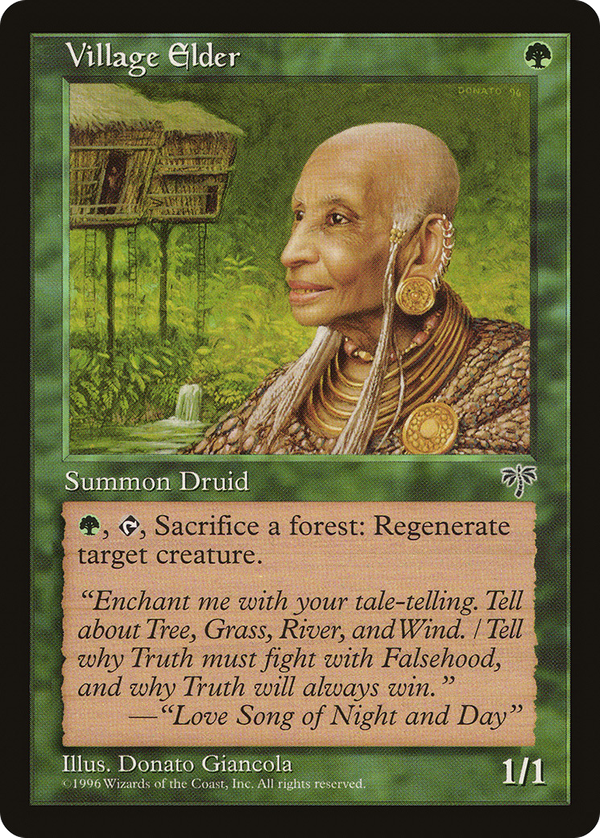
Rules text
,  , Sacrifice a Forest: Regenerate target creature.