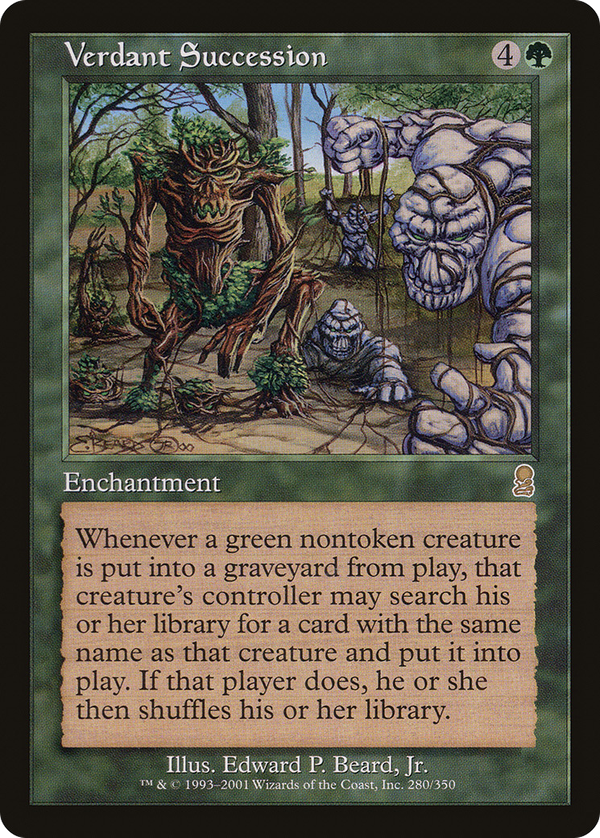
Verdant Succession


Built around a recursion loop that almost no green creature actually rewards: when one dies, its controller tutors a fresh copy of the same card straight onto the battlefield. The name-matching clause is the entire constraint, since the engine only pays off when you run multiples of a creature whose death does something worth repeating. In the four-of formats this kind of design came from, that pointed toward a narrow set of build-arounds: green creatures with strong dies-triggers or enters-the-battlefield value, stacked deep into a dedicated shell so each death immediately refunds another. It is a library-driven replacement that fetches a new copy rather than returning the old body, so the creature comes back fresh, with no counters or graveyard residue attached. But the trigger hinges on the word "dies," and that sets a hard ceiling on what it answers. The creature has to reach the graveyard from the battlefield for anything to happen at all: exile and bounce removal sidestep the engine entirely, and a replacement effect like Rest in Peace that stops creatures from ever dying shuts it off at the source. Against ordinary destruction, though, it offers inevitability: the opponent has to answer the same threat twice while you replace it at no card cost. The price is structural. The enchantment costs five and sits inert until a creature has died, and the same-name restriction caps the redundancy. A deck-defining card that asks you to abandon variety in your creature base, then makes that sacrifice the strategy.