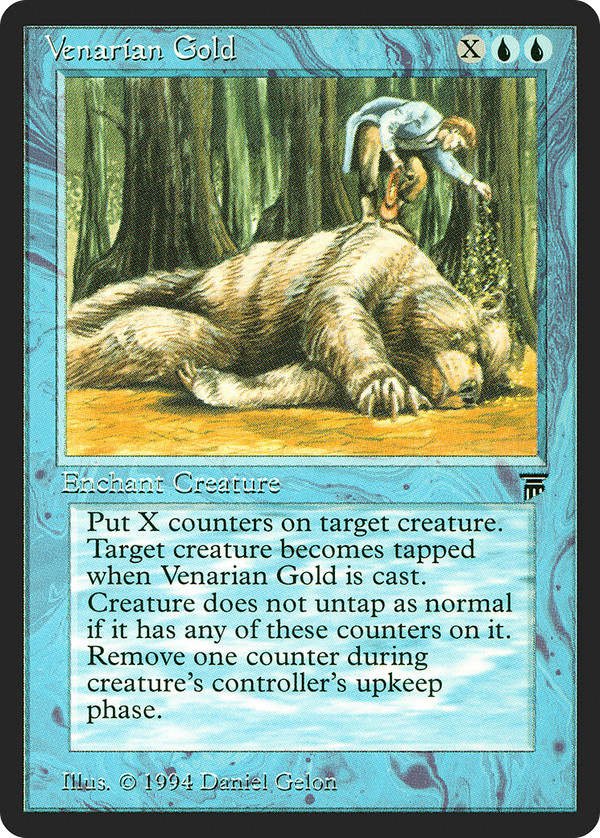
Venarian Gold


Sleep counters as a tempo tax: the design is an X-cost lockdown that scales with how long you want the creature offline, and it pays for itself the moment it lands because the enter-the-battlefield trigger taps the target before the upkeep clock starts. That is the whole structural trick. The counters tick down on the enchanted creature's controller's upkeep, so each point of X buys one of their turns; you are essentially pre-paying for future Time Walks against one body, with the first turn (the tap-on-entry) thrown in as a bonus. The Aura framing is what dates it. Modern lockdown effects of this shape almost always sit on instants or sorceries (Lay Bare the Heart, Sleep itself) because attaching a long-duration disable to an Aura means a single removal spell on the Aura frees the creature early and refunds the opponent's investment, while a single removal spell on the creature wastes the lock entirely. Aura-as-tempo was a Legends-era reflex: Paralyze, Psionic Entity, the whole school of permanent-based soft locks that newer design has largely retired in favor of one-shot effects with clearer accounting. The sleep-counter mechanic itself has been revisited (most visibly on the Kamigawa cycle), but always on creatures or instants, never again on a scaling Aura. Venarian Gold is the prototype that showed why the chassis does not hold up.