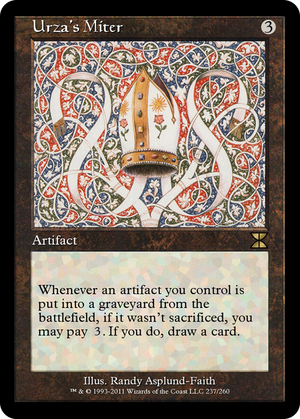
Urza's Miter

A draw engine bolted to the artifact graveyard, with a sacrifice exclusion clause that tells you exactly what the card is for and what it isn't. The "if it wasn't sacrificed" rider is the load-bearing line: this is not an aristocrats payoff, not a Krark-Clan Ironworks fuel pump, not a piece of any deck that wants to turn its own artifacts into resources on purpose. It is built to extract value from the opponent's removal, the combat step, and the natural attrition of an artifact-heavy board. The cost structure does the rest of the gating: a flat to play, then again each time you cash in a dying artifact, with no tap, no charge counters, no scaling. Once it is down, the casting cost is paid off; every card after that runs you a payment and the loss of a permanent, which is the rate Antiquities was willing to put on repeatable card draw outside blue. The mechanical lineage is clear in retrospect, the through-line that runs to Skullclamp: artifacts that convert dead permanents into fresh cards. What dates this design is the manual pay-per-draw and the sacrifice exclusion, which together gate the engine behind the opponent's cooperation. What still reads as modern is the recognition that artifact decks generate a steady supply of dying permanents on their own, and that charging a stiff price to cash them in is a defensible way to price repeatable draw onto a colorless permanent.
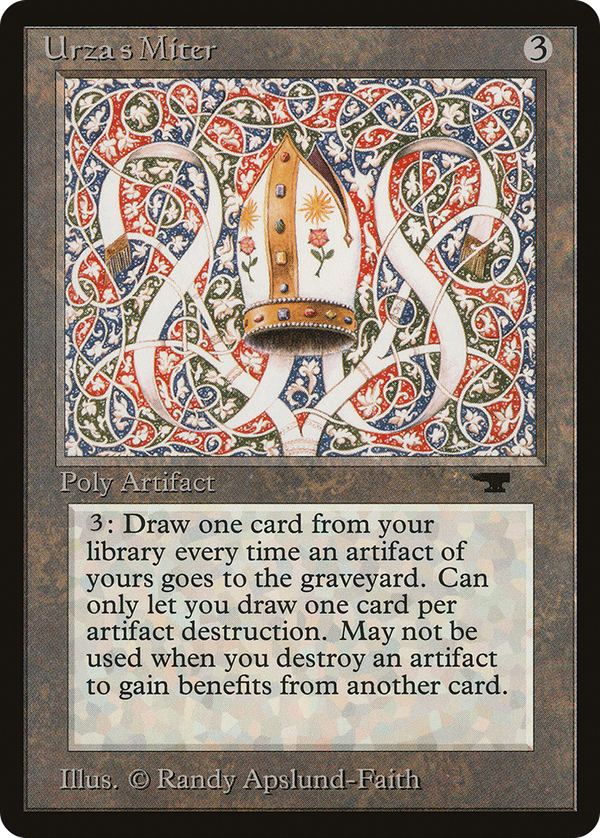
Rules text
. If you do, draw a card.