Up the Beanstalk


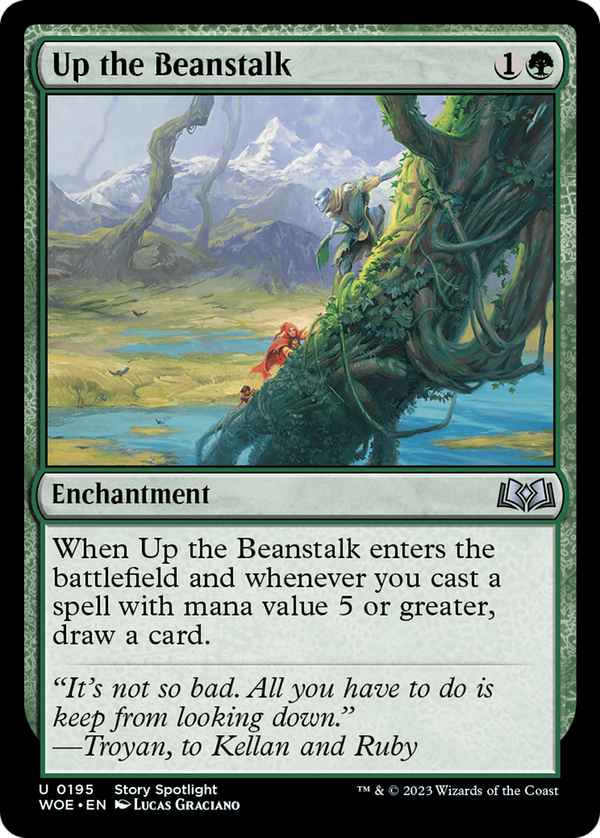
Five is the only number that matters here. Casting a spell with mana value five or greater draws a card, and once you frame a deck around that threshold, "expensive" stops meaning "slow" and starts meaning "profitable." A seven-mana bomb becomes a threat that replaces itself; a big-mana spell you were casting anyway now cantrips on the way in. The ceiling is what gives the design its teeth: nothing caps how many heavy spells you can chain, so it rewards a deck with a deep top end rather than a single expensive finisher. The floor is what keeps it honest. Deploy it for two mana, take your one draw on entry, and then run out a curve of two- and three-drops, and it does nothing at all: an idle enchantment waiting for spells your deck never plays. That gap between cheap to cast and dead unless you go big is the entire cost of admission. It belongs to a lineage of green card-advantage engines that gate their reward behind a casting-cost threshold rather than a per-turn tax, closer in spirit to a cost-reducer that only wakes up around a certain mana value than to a straight draw spell. Play big, get paid; the enchantment asks nothing more and offers nothing to a deck that curves out cheap.