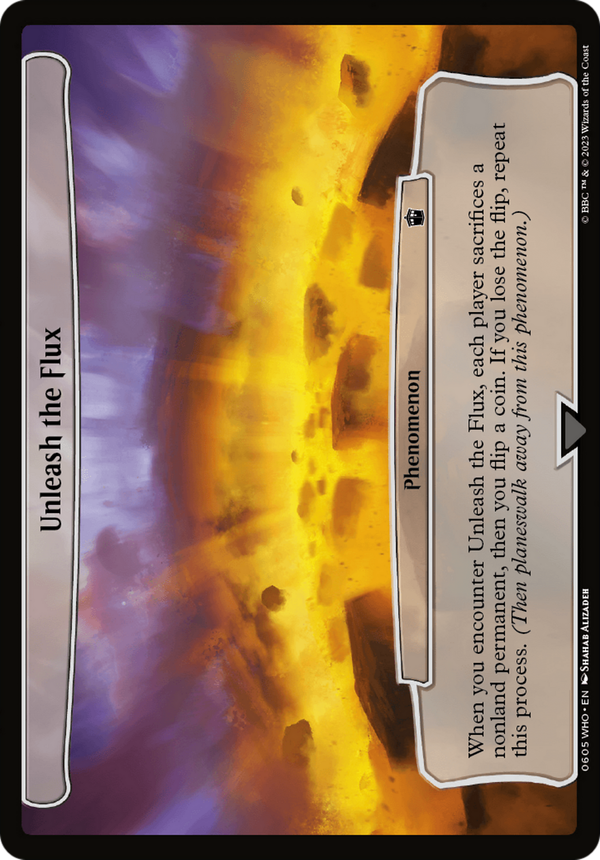
Unleash the Flux
Phenomena do not sit in a hand waiting to be cast; they are drawn from the planar deck and resolve the instant the planar die walks you into one. That mechanism is what gives this its teeth. A symmetrical edict is old news, but the coin flip turns it into a loop with no fixed depth: lose the flip, and every player sheds another nonland permanent, and you flip again, and the table keeps emptying until someone's luck finally holds and you planeswalk away. Nothing caps the process, so the worst case is a wipe that scales with the coin and with how many permanents the table can keep offering up. What does the delicate work here is the self-selection clause: each player picks what to give, which means the mana rocks and spare tokens go first while the real threats ride out the early flips. A go-wide or token board treats the loop as a formality, feeding chaff into flip after flip and losing nothing that matters; a lean board holding two genuine threats has nothing to hide behind and starts hemorrhaging its actual game plan on the second or third iteration. It belongs to a design tradition where randomness is the format's premise rather than a bug in it, a deliberate break from the deterministic contract the sixty-card game otherwise offers. You do not build around it; you consent to it by sitting down with a planar deck at all.