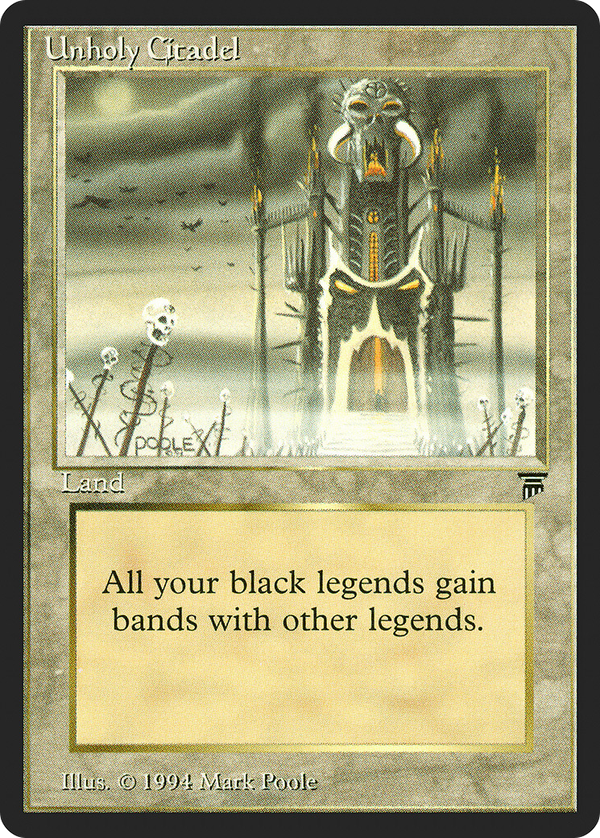
Unholy Citadel
A tribal lord for legends, paid for out of the land slot rather than the creature slot: that is the strange shape underneath this card, and it depends on a population of legends the era's card pool could not put on the battlefield. The grant is a banding variant, "bands with other legendary creatures," handed only to the black legends you control, and the damage-assignment clause is the real payload. A black legendary blocker bands with another legend you control, and you choose how the attacker's combat damage splits across the blockers. That is a defensive tool dressed as an aggressive one, and it only matters once enough legends are on the table to band at all, which in 1994 meant essentially never; the uniqueness rule of the day capped each legend name to one in play across the whole game, so the prerequisite the card depended on was structurally rare. What makes it worth a second look now is the design instinct on display: Wizards trying to give the legendary supertype a mechanical identity beyond uniqueness, decades before that supertype became the chassis for entire formats. The execution leaned on banding (the rules continent designers now point at to explain why ability words need discipline) and on a board the game would not assemble for years. The execution was wrong; the question the card was asking turned out to be the right one.