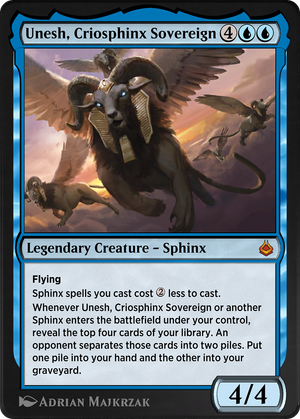
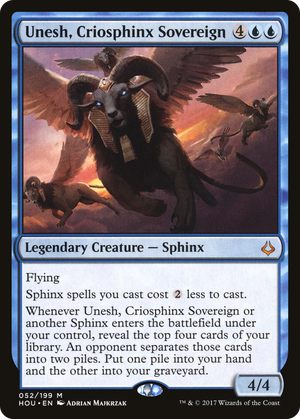
Unesh, Criosphinx Sovereign


Most tribal payoffs pull in one direction: a cost reducer buys down spells, a card-advantage engine refills the hand. This one welds both to a single evasive body, and the more interesting half is the part that hands a decision to the other player. The reduction makes a curve of expensive Sphinxes castable, and every Sphinx that lands (this one included) reveals the top four; the split of labor is the trick. The opponent sorts those four into two piles, and the controlling player then takes one pile to hand and buries the other in the graveyard. This is Fact or Fiction's adversarial geometry, ported onto a repeatable creature trigger: because the cards are revealed and everyone can see them, the opponent's job is to divide them so no split is obviously better than the other, since any lopsided pile just gifts the controller the good half. The design bet is that for a deck built to abuse this, a few cards falling into the graveyard is a soft cost (bombs you can still reach from the yard, or cards you were never going to draw), and that stacking multiple triggers in one turn overwhelms the opponent's careful splitting: each new pile-splitting problem gets harder to keep even. The split clause is where the card actually lives. Flat card draw would have been a duller engine and a less honest one, trading the tension of a shared, watched decision for a rote refill.
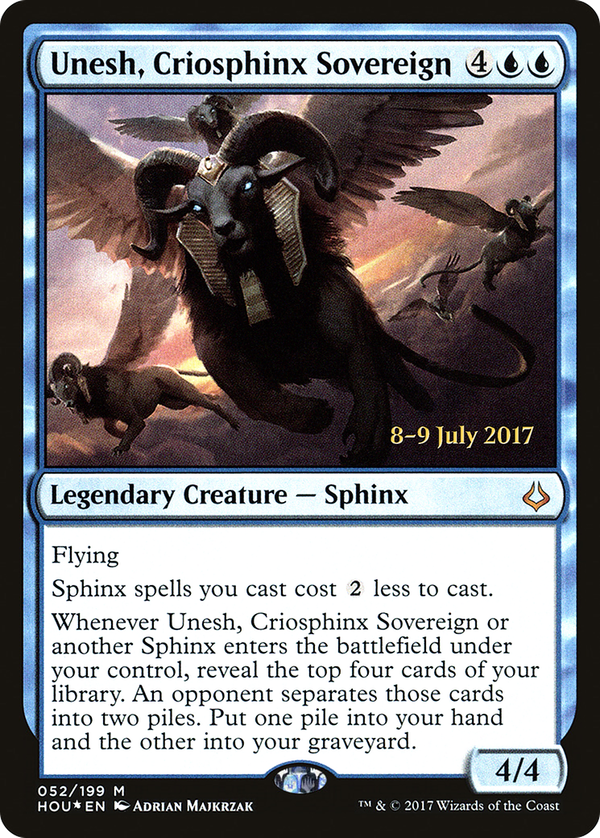
Rules text
 less to cast.
Whenever Unesh or another Sphinx you control enters, reveal the top four cards of your library. An opponent separates those cards into two piles. Put one pile into your hand and the other into your graveyard.
less to cast.
Whenever Unesh or another Sphinx you control enters, reveal the top four cards of your library. An opponent separates those cards into two piles. Put one pile into your hand and the other into your graveyard.