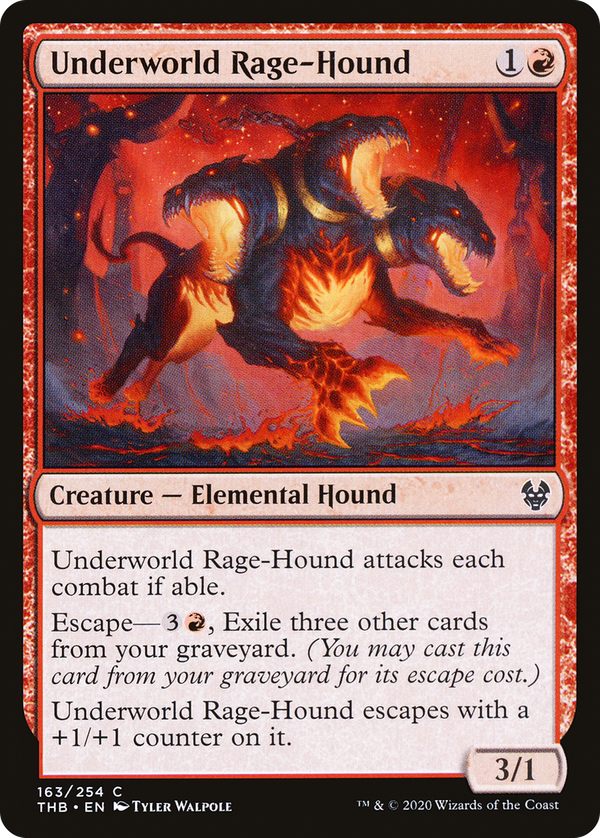
Underworld Rage-Hound


A 3/1 for two that swings every combat whether you want it to or not is the kind of aggressive downside red used to attach to cards freely; the compulsory attack is the price you pay for the rate. What makes the design sing is how escape reframes that liability into an asset. The body is built to trade or die, and it wants to: a one-life creature that must attack is going to hit the graveyard fast. Escape then turns that graveyard trip into a feature, buying the card back for a mana premium and a fuel cost of three exiled cards, returning slightly larger each time thanks to the +1/+1 counter it escapes with. The recursion has a hard ceiling built in: every trip consumes three other cards from the yard, so the same graveyard that enables it also gets rationed away. That tension is the whole engine. A creature that suicides into blockers is normally card disadvantage; here, dying is a step in the loop rather than the end of it, and each return grinds you a little further ahead as long as the graveyard can pay. It is a compact statement of what escape as a mechanic was after: making the graveyard a resource you spend deliberately rather than a place cards go to be forgotten, with a threat that is happy to keep feeding itself back onto the battlefield.
Rules text
 , Exile three other cards from your graveyard. (You may cast this card from your graveyard for its escape cost.)
This creature escapes with a +1/+1 counter on it.
, Exile three other cards from your graveyard. (You may cast this card from your graveyard for its escape cost.)
This creature escapes with a +1/+1 counter on it.