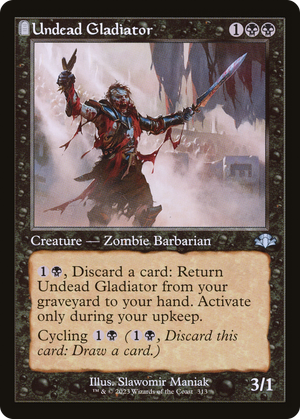
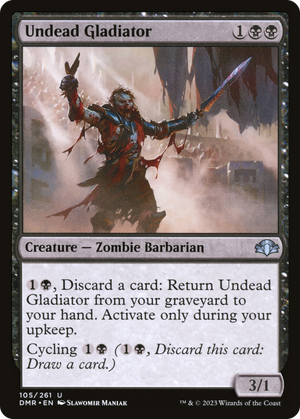
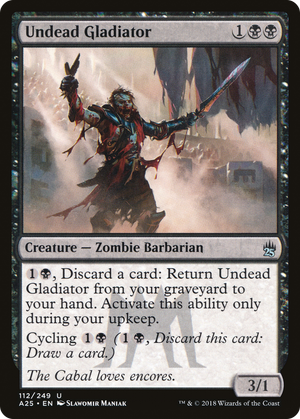
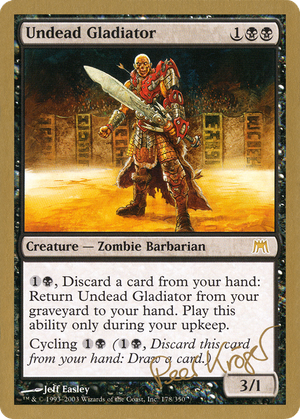
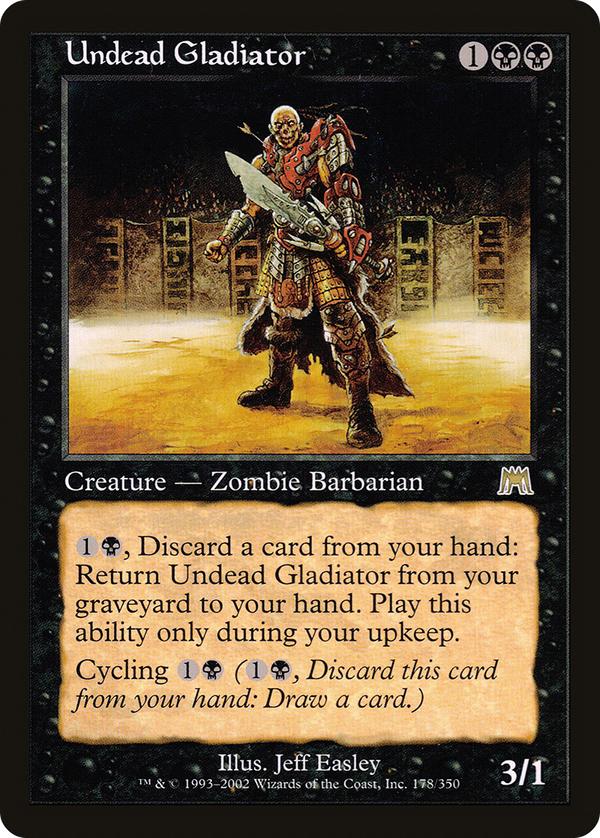
Undead Gladiator


Most creatures with cycling are designed to soften the dead draw: when you don't want the body, you pitch the card and dig a layer deeper. This one refuses to stay buried. The cycling cost and the upkeep recursion cost are nearly identical ( either way, both asking you to discard a card), which means the design wants you to cycle it early, then on a later upkeep pay , discard something else, and pull it back to hand, ready to recur, replay, or cycle again. The graveyard is not a failure state here; it is the parking space.
Run the math, though, and the loop is filtering, not card advantage: cycling trades the Gladiator for a draw one-for-one, and the upkeep return trades a discarded card for the Gladiator one-for-one. The engine never nets a card. What it does is smooth draws turn after turn, letting a deck shed flood, dump graveyard payloads, or feed discard-matters effects on a recurring loop, all while threading the same threat through the cycle. The 3/1 body is almost incidental: it can attack when the board allows, but the intent is to keep the creature shuttling between graveyard and hand rather than parking on the battlefield. Among the earliest creatures built to treat its own death as a renewable resource, its trick is the symmetry between its two costs, which keeps the loop turning indefinitely instead of stalling out.
Rules text
, Discard a card: Return this card from your graveyard to your hand. Activate only during your upkeep.
Cycling (, Discard this card: Draw a card.)