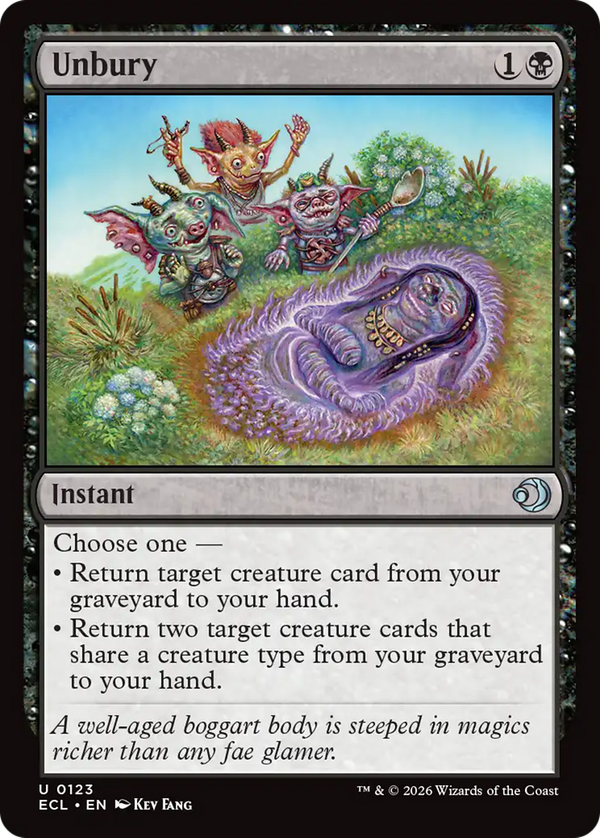
Unbury


Raise Dead has been black's baseline single-target recursion for as long as the game has existed, and this splits the difference between that clean rate and the reach a tribal deck actually wants. The first mode is the familiar effect at a one-mana tax, a floor that keeps the card live even when your graveyard is a jumble of unrelated creatures. The second mode is where it earns its keep: pull two creature cards back for a single spell, provided the pair shares a creature type. That shared-type clause is the whole balancing act, and it is worth being precise about what it checks. It does not read your board or scale with how many creatures you have; it simply requires that the two cards you target share a creature type, which means a concentrated tribal build cashes in where a five-color graveyard pile comes up empty. What separates it from most black recursion is instant speed. Black's answers to attrition have historically been sorcery-speed rebuilds, cast on your own turn after the dust settles; this can be held up through an opponent's turn and cast the moment a spot removal spell or a discard effect strands the cards in the graveyard for good, reclaiming them rather than waiting a full turn to react. The modal frame does quiet work too: a spell that would otherwise be dead against a shallow graveyard always has its single-target line to fall back on.