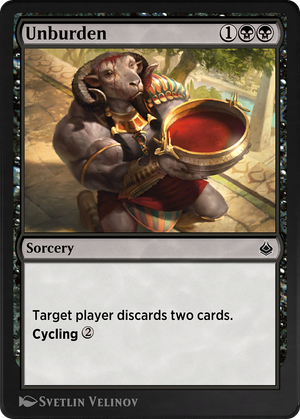
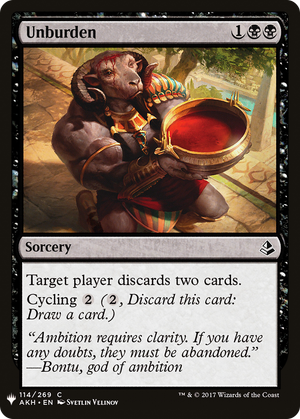
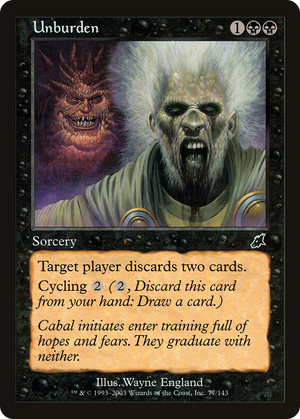
Unburden


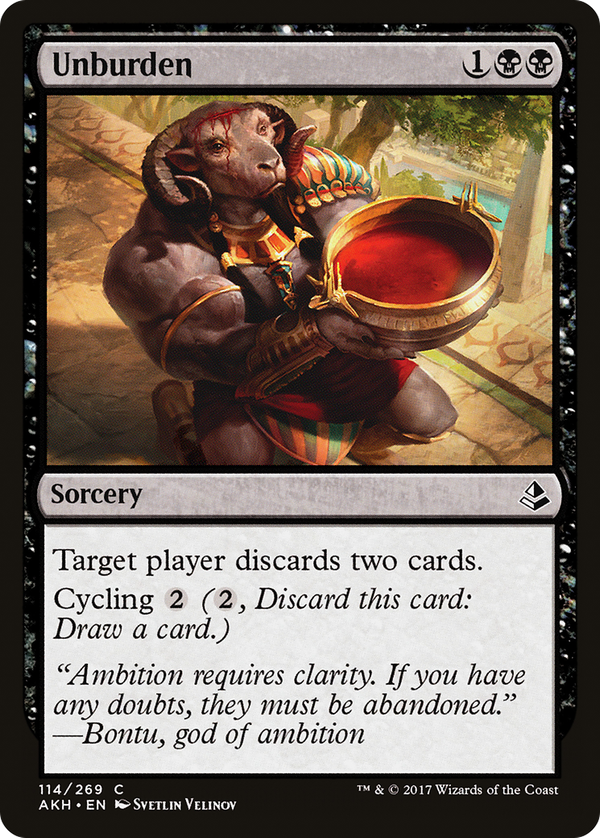
Targeted discard at three mana asks for two cards from one player, which is the kind of resource attack that has always lived best when the discard is the early-game disruption and not the whole plan. What separates this from straight discard like Mind Rot is the escape hatch printed underneath: when an opponent has already emptied their hand, or when you simply drew it past its window, it stops being a dead card and converts into a fresh one for two mana. That hedge is the entire reason a sorcery this slow earns a deck slot. A two-for-one discard spell is unappealing in any matchup where the opponent is hellbent, and discard's worst trait has always been turning into a blank in topdeck wars; cycling answers exactly that failure mode without softening the front-side effect at all. The design is a small lesson in how the cycling keyword was used during its era as insurance against situational cards rather than as a payoff in itself. The discard does what discard does, and the cycling cost (notably higher than the era's one-mana cyclers) is the tax you pay to never be punished for drawing it at the wrong moment.
Rules text
 (, Discard this card: Draw a card.)