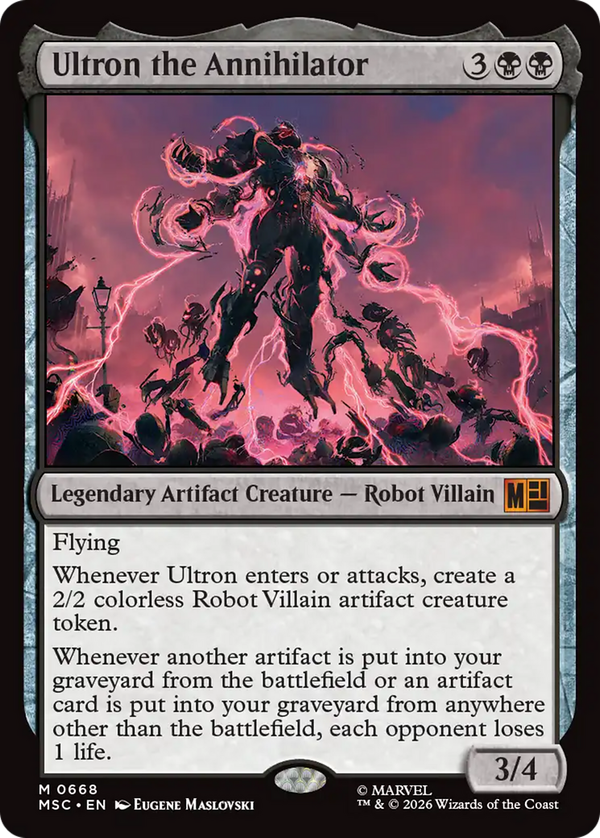
Ultron the Annihilator


Two engines welded into one body, and the seam is what makes it work. The token side reads like an aggressive commander: a 3/4 flyer that spawns a 2/2 on the way in and again on every attack, building a board that refuses to stay small. But those tokens are artifacts, which quietly turns the drain trigger into a payoff for their own deaths. Sacrifice a Robot token to an outlet, crack a Treasure, feed a Krark-Clan Ironworks: each other artifact leaving the battlefield for your graveyard costs every opponent a life, and artifact cards hitting the yard from anywhere else (mill, discard, a countered artifact spell) fire the same trigger. The card manufactures its own fuel, then rewards you for burning it, though the burning is on you: it makes the fodder and the payoff but never the sacrifice outlet, so the deck around it has to supply the button that closes the loop. The drain resolves in single points, which pushes the ceiling into throughput rather than any one trigger, and that is precisely why the card wants a dense artifact shell rather than a slow value pile. It sits where black's life-loss tradition meets colorless artifact recursion, a place Marvel's Ultron is a fitting occupant for: a machine that wins by counting the machines it consumes.