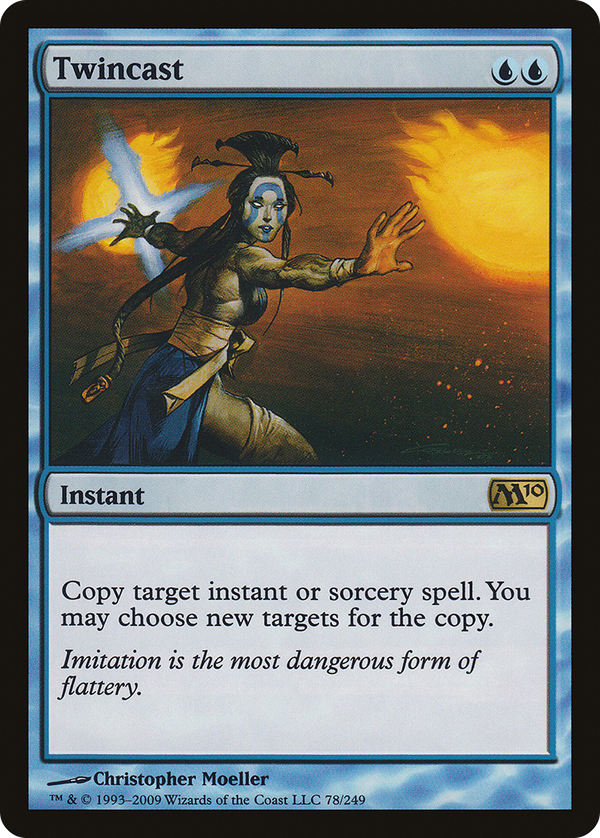
Twincast

Copying a spell already on the stack is a different animal from casting your own, and the design lives in that difference. The original spell pays its cost and announces its targets; the copy is placed on the stack above it, owing nothing and free to point its damage, its draw, or its kill spell wherever you like. That turns the card into a tax-free mirror of whatever the table just committed to: an opponent's burn aimed back at them, a tutor doubled into your own search, a counter turned against the counter. The dependency is structural and steep: it needs a worthwhile instant or sorcery sitting on the stack to copy, so it does nothing in isolation and everything as a response. That is why it never settles into fair decks and gravitates toward combo shells, where the spell worth copying is one you control and the copy converts a single payoff into two. The "you may choose new targets" clause is doing the heavy lifting: without it, the copy would inherit the original's targets verbatim and most of the redirection tricks would vanish. The result reaches back to an old blue idea, that the most efficient answer is often to reuse the question someone else already asked, and pays for that flexibility with total reliance on someone else asking it first.