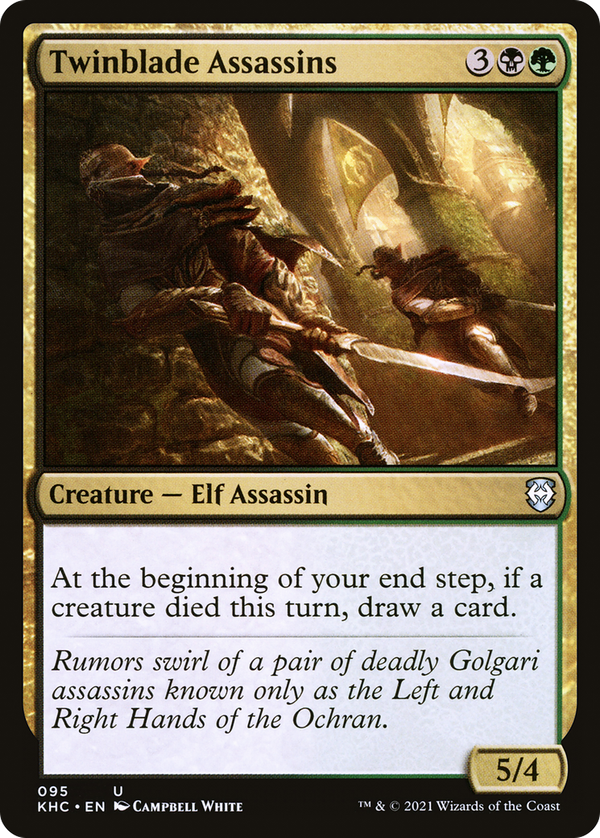
Twinblade Assassins



The trigger asks for the lowest possible bar: one creature, anywhere on the battlefield, has to have died before your end step. Yours, theirs, a token, a sacrifice, a chump block in combat. It does not care whose creature, does not care how, does not care how many. That looseness is the whole design, because a five-mana 5/4 that just sat there would be filler; a five-mana 5/4 that refuels every turn a body hits a graveyard is an engine wearing a beater's stats. Black-green has always paid its card advantage in death, from Grim Flayer's delve fuel to the long line of sacrifice-and-draw effects, and this sits in that lineage as the passive version: no outlet to activate, no life to pay, just a standing tax on the board that turns any attrition into gas. The catch that keeps it fair is the timing. The check happens at your end step, not continuously, so a creature that dies during your opponent's turn does nothing for you; you only cash in on deaths that land before the beginning of your end step. That single-window constraint keeps it from spiraling into a runaway engine, and it rewards decks built to make sure something dies every turn on your clock rather than hoping the game supplies the bodies.