A four-mana instant that finds nothing on resolution unless you have already drafted at least four differently-named legendary creatures worth tutoring, and the opponent then hands you the two least useful. The set is dense with legends, so the floor is higher than usual; the ceiling stays low because no Limited pool holds four legends that each carry a game on their own. The split clause guarantees you get the leftovers. There is no deck in TMT that wants this maindeck, and the games it would swing do not come up in a forty-card pool.
Turtles Forever
Instant

Format takes
How this card plays
7 reviews
The opponent-chooses clause inverts how you build the four targets. Because your opponent picks the two cards that go to your hand, you cannot assemble a combo and trust them to hand you the pieces; they will give you the two that matter least. So the search rewards four legends where any pair solves a different problem on its own: a removal legend, a recursion engine, a flash finisher, a stabilizer. That is a deckbuilding puzzle, not a tutor chain, and the depth of the toolbox is what determines whether the card earns its slot.
Kethis, the Hidden Hand is the cleanest home, a legend-matters commander whose ninety-nine already runs twenty-plus legendary creatures, so the search has reach and the graveyard recursion gives the fetched bodies a second life. The "outside the game" clause matters, but it does not bend the rules: Rule 0 wishboards still obey singleton and color identity, so you are not cheating extra copies of the strongest legends. What you gain is the freedom to keep four situational answers off the deck entirely and fetch them at instant speed, dodging a sorcery-speed wrath and arriving on an end step with a reactive legend already in hand.
This is a Bracket 2-3 card. It is too slow and too opponent-dependent for cEDH, where a four-mana tutor that hands the table veto power sits well below Demonic Tutor or Vampiric Tutor. The political read is real: revealing four legends telegraphs the plan, and the opponent picks by reading your board.
In a legends-dense build it fills the eighth or ninth card-selection slot alongside Captain Sisay, who repeatably tutors a legendary permanent into hand at sorcery speed. Turtles Forever trades Sisay's grindy single-target loop for instant-speed breadth.
Modern has no home for a four-mana instant that fetches legendary creatures and lets your opponent keep the two best ones. The format's tutors find lands or fast combo pieces; this finds a midrange toolbox that no Modern deck is built to abuse, and the two-and-two split punishes exactly the singleton-finder use a wishboard wants. Legal, but yet to register in tracked tournament play, and there is no archetype here asking for it. This is a Commander card wearing a Modern legality.
Legal since its March 2026 release, but yet to register in any tracked Standard deck this season. The gap is structural, not incidental. A four-mana instant that finds four legendary creatures from anywhere should be a centerpiece, but the opponent-chooses-two clause makes the card only as good as the bottom two cards in your search, and Standard's legendary pool does not offer the redundancy this asks for. To make it work you need four legends where any pairing wins a game on its own, all castable inside a deck that can also survive to four mana. The current pool does not assemble that quartet at the power level Standard's top decks demand, and a four-mana setup turn that hands your opponent the steering wheel is a hard sell against the format's aggressive lines. The instant speed is real value, but it is value attached to a search nobody has found a payoff for.
That is a present read on the announced pool, not a verdict on the card. The two-and-two split rewards a critical mass of game-ending legends, and the moment a set prints three or four of them at the right cost, the math changes.
Turtles Forever is a recent print and does not face rotation in the near term; it stays Standard-legal well past the fall 2026 cycle. The more relevant clock is inbound rather than outbound: this card needs the format to grow into it, and that depends on legends Wizards has not yet printed. Until then it sits legal and unplayed, waiting for partners the current pool does not contain.
Legal in Pioneer since its spring 2026 printing, and so far it has not registered in tracked tournament play. The absence is structural, not a matter of the meta having missed it.
The card needs a deck that runs a critical mass of singleton legendary creatures, each a standalone answer, so that any two of the four the opponent leaves you still solve the game. Pioneer does not have that deck. The format's legendary-creature density lives in places that do not want this effect: Mono-White Humans runs Thalia, Guardian of Thraben as a beater rather than a toolbox piece; Rakdos Midrange leans on Sheoldred, the Apocalypse as a singleton finisher but otherwise plays redundant non-legendary threats; Mono-Green Devotion's legends (Nissa, Who Shakes the World, Kiora, Behemoth Beckoner) are devotion enablers, not interchangeable tutor targets. None of these decks would trade a four-mana instant for a search that hands the opponent the right to deny the two best cards.
The "outside the game" clause is also dead in tournament Pioneer, where sideboard wishing has no support: there is no companion or wish framework that lets you build a useful board around it.
What the design rewards, a singleton-legend toolbox where every piece carries a game alone, is a Commander deckbuilding exercise, not a Pioneer one. The 60-card format wants four-ofs and consistency, which is exactly the opposite of the puzzle this card sets. No active slot conversation exists, because the archetype that would run it is not in the format's map.
Vintage tutors cheap and never give the opponent a vote: Vampiric Tutor sets the top card for one mana, Mystical Tutor feeds the brokenness on top, Demonic Tutor finds any card for two. This wants four mana, finds four legends, and lets the opponent steer which two reach your hand while the rest shuffle back. The instant speed is real, but it does not rescue a four-mana payoff in a format that goldfishes on turn one off Lotus and two Moxen, and the opponent's split guarantees you never get the two pieces that matter most. Noise; legal, but yet to register in tracked Vintage play.
A four-mana instant that fetches four different legendary creatures and lets your opponent hand you the two worst, which is not a Legacy rate at any point in the search. The format's tutors are faster, narrower, and unconditional: Enlightened Tutor sets up at one mana, Imperial Recruiter and Green Sun's Zenith put the body where you want it without a vote. Legal, but it has yet to register in tracked tournament play, and there is no Legacy shell asking a white toolbox to clear this bar. Binder filler here.
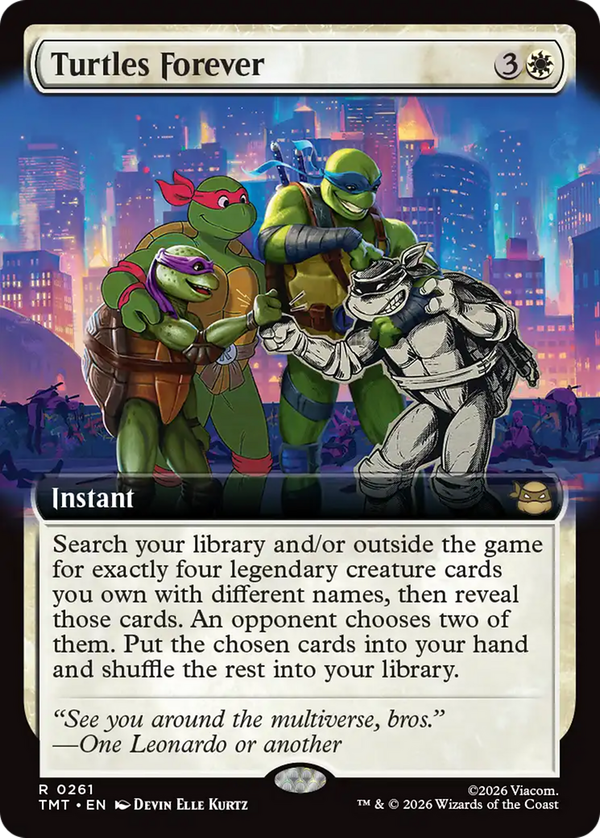
TMT · #261rare
Pricing
Normal: $1.33
Foil: $1.62
Oracle Text
Rules text
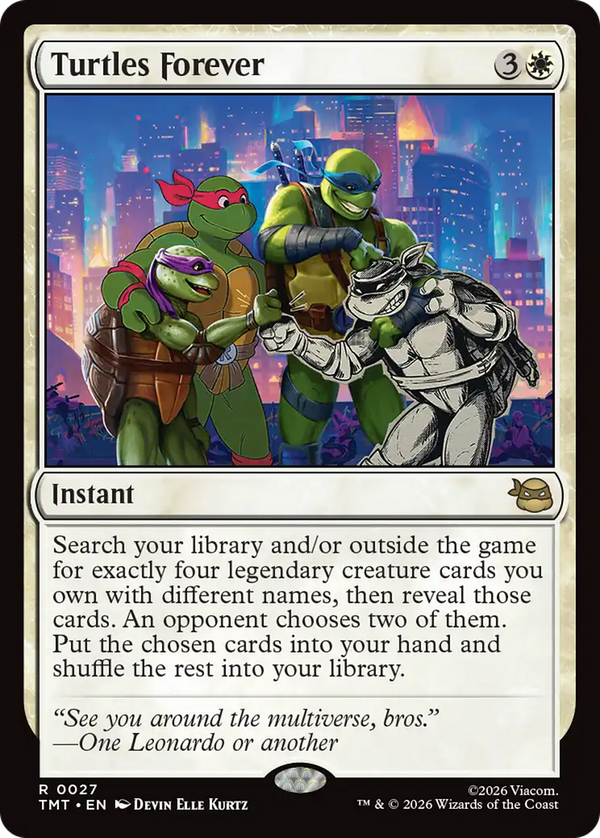
Search your library and/or outside the game for exactly four legendary creature cards you own with different names, then reveal those cards. An opponent chooses two of them. Put the chosen cards into your hand and shuffle the rest into your library.
Legalities
Format Status
Standard
Legal
Pioneer
Legal
Modern
Legal
Legacy
Legal
Vintage
Legal
Commander
Legal
Pauper
N/A
Brawl
Legal
Historic
Legal
Alchemy
Legal
Timeless
Legal
Standard Brawl
Legal
More formatsFewer formats
Old School
N/A
Premodern
N/A
PreDH
N/A
Pauper Commander
N/A
Oathbreaker
Legal
Gladiator
Legal
Penny Dreadful
Legal
Duel Commander
Legal
Future Standard
Legal
COMPETITIVEBRAWL
Legal
TLR
N/A