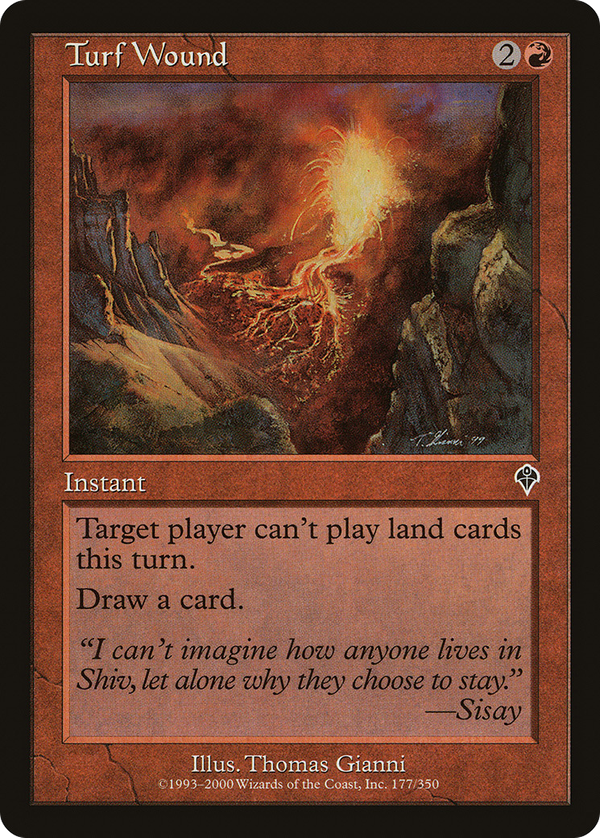
Turf Wound


Denying an opponent their land drop for a single turn is a strangely surgical effect, and the cantrip stapled to it is what keeps this from being a dead card the rest of the time. The use case is narrow but real: a tempo deck that has stalled an opponent on lands, or a player holding up a turn where the opponent desperately needs to hit their next drop to cast something. Stranding a key land in hand for one turn buys a clock exactly one tick of breathing room. The catch is severe, though: the window is tiny and the payoff conditional, so most of the time the opponent simply plays the land next turn and you have spent three mana to draw a card you could have drawn more cheaply. That tension (a disruption effect that only matters under specific board states, bundled with a baseline cantrip so it is never a total blank) is the whole reason the card exists in the form it does. Drawing a card sets the floor that makes the gamble palatable; the land denial is the ceiling you reach only against the right opponent at the right moment.