Turbulent Steppe
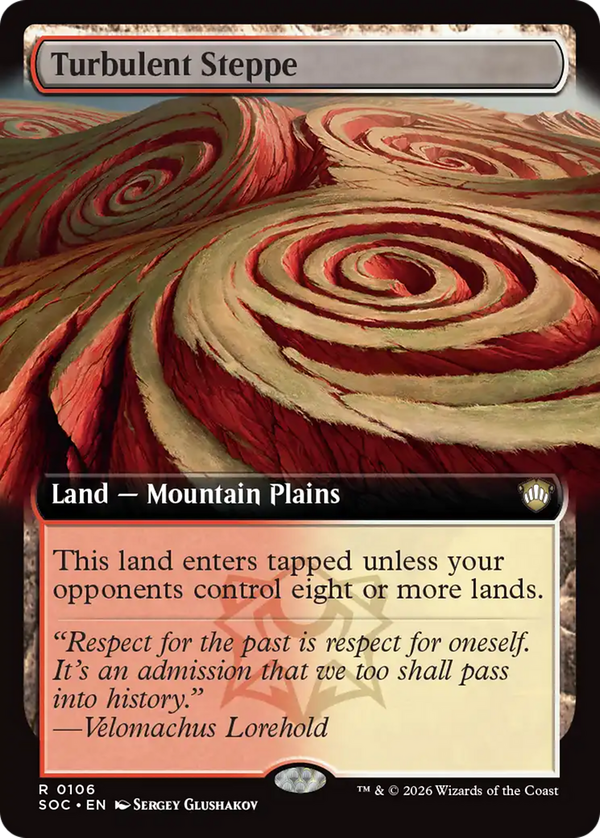
Most conditional duals read your own side of the board and reward you for keeping it lean: a low land count, a full grip, a life total under a line. This one inverts the check entirely and reads across the table, entering tapped unless your opponents control eight or more lands. That reframes a tapland's whole cost structure. Heads-up, a single opponent almost never assembles eight lands, so the card is a tapland effectively every game. At a crowded table the threshold clears more readily: opponents collectively reaching eight lands flips it, which grows likelier as the game goes long. So the untapped clause is not really a late-game reward; it is a multiplayer default. Whenever it does enter untapped, it fixes between red and white right as multi-spell turns start taxing a mana base. The downside is mild and self-correcting: the tapped entry only bites in games short enough or small enough that you were probably fine on mana anyway, and the base line gives up nothing, tapping for red or white like any plain dual. The interesting design move is that the drawback is calibrated to disappear precisely in the environment the card was built for.
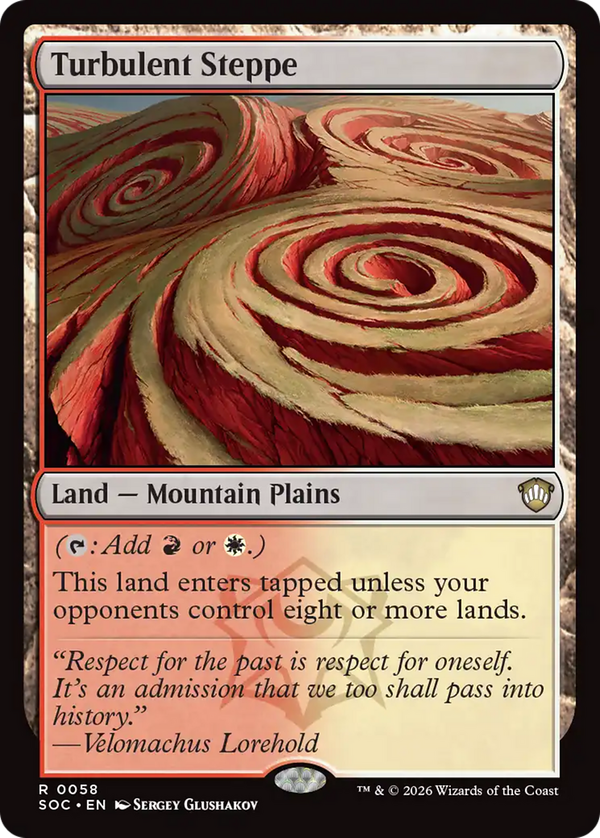
Rules text
 : Add
: Add  or
or  .)
This land enters tapped unless your opponents control eight or more lands.
.)
This land enters tapped unless your opponents control eight or more lands.