Trip Up


The interesting detail is who makes the choice: the permanent's owner, not the caster, decides whether the tucked object goes top or bottom of their library. That single clause keeps the effect out of pure denial territory and turns it into a negotiation the opponent controls. A tempo bounce like Boomerang or Unsummon returns a permanent to hand, buying a turn while the threat stays recastable at will. Sending something back into the library is stiffer, because the owner has to spend a draw redrawing it, but the owner will only tuck to the top when reloading that card beats everything else left in the deck; against a hard-cast bomb they can bury it deep and reset their draws instead. You are buying tempo and disruption, not dictating the outcome. The wider wrinkle is that it reads any nonland permanent, so the enchantment answer, the artifact answer, and the creature answer collapse into one instant that never technically destroys anything. That refusal to trade for real card advantage is the ceiling: you spend a card and mana to rearrange, not to kill. Cycling exists to soften that ceiling. When the board offers nothing worth resetting, the card cashes itself for a fresh draw rather than rotting in hand, the standard hedge for an answer whose relevance swings hard on what is across the table.
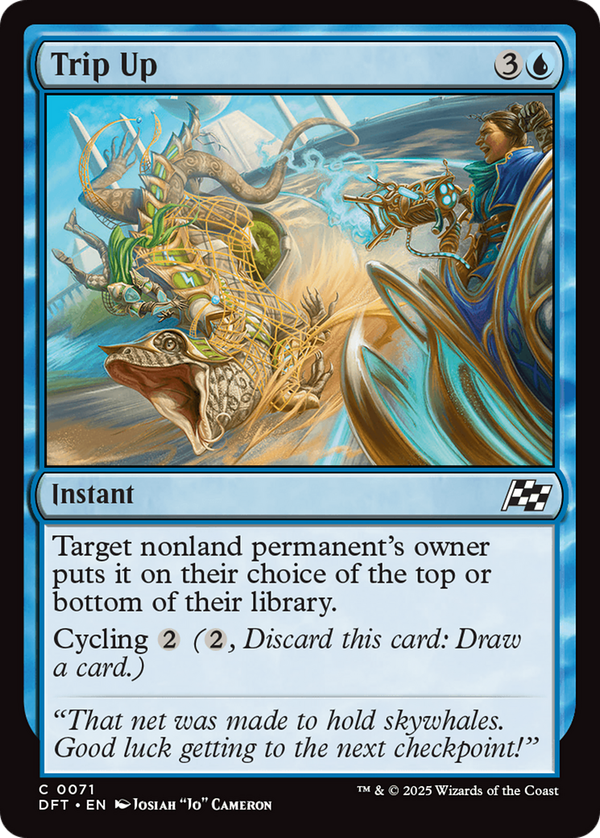
Rules text
 (, Discard this card: Draw a card.)