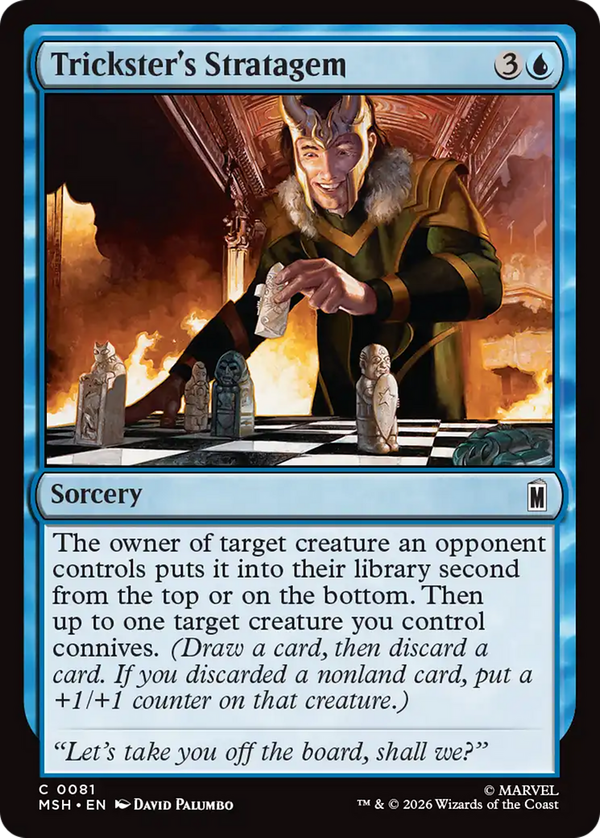
Trickster's Stratagem


Blue's threat answers have always leaned on impermanence: return it to hand and they recast it, tuck it a few cards deep and they redraw it soon enough. The wrinkle here is that the destination is not the caster's to pick. Because the spell targets a creature an opponent controls, that creature's owner is the one choosing between second from the top and the bottom of their library, and a rational owner takes whichever hurts them least. Against a top-heavy hand they bury it; against an empty grip they slot it second and see it in two draws. That flips the framing entirely: this is not flexible tuck removal you point wherever it stings most, but a delay whose severity the target's owner gets to soften. It buys tempo, sometimes a lot of it, but never fully on your terms.
The connive rider is what redeems the sorcery-speed clunk. Answering a creature on your own turn is slow and card-negative, so the spell repays you on your side of the board: dig a card deeper, pitch the excess, and if what you ditch is a nonland, one of your creatures grows. That final clause nudges toward a deck with a body worth pumping rather than a pure permission pile. Removing a blocker, smoothing your draw, and advancing a threat in one card is more than blue's tuck effects have historically bundled; the catch is that the opponent, not the caster, sets the price of the removal half.