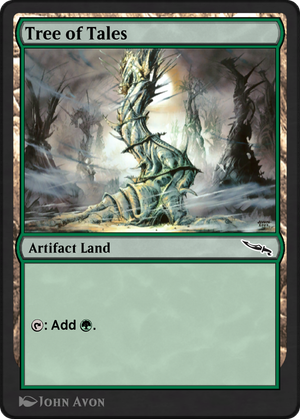
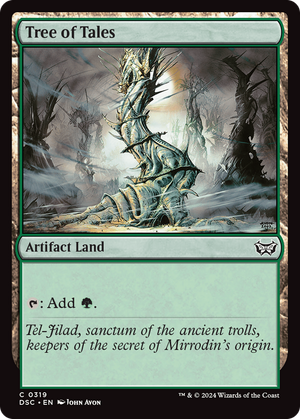
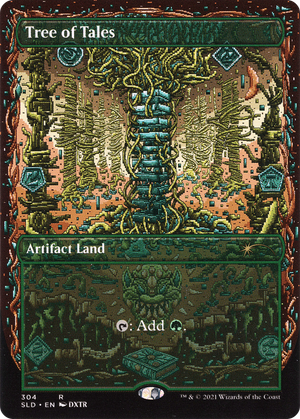
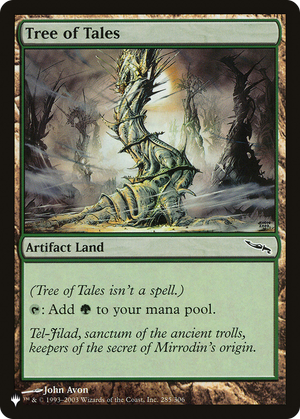
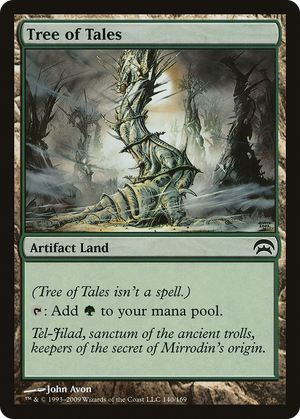
Tree of Tales
The artifact-land cycle answered a question the game had mostly sidestepped: what if your mana base could also pad your artifact count? Tapping for green is unremarkable, but carry the artifact type as well and the same source feeds affinity, dies to Shatter, and adds to Cranial Plating in a way a Forest never could. That was the entire point of the five, and also why they became a recurring problem child. The property that lets a deck inflate artifact density also makes the mana base fragile to disruption ordinary lands shrug off: a removal spell aimed at an artifact creature can erase your green source instead.
This is the green member, and green's role in the shells that abused the cycle was always the thinnest, which is why it tends to be remembered as the quietest of the five. The trade is the part worth lingering on: a free land that produces mana while quietly swelling a separate resource count, paid for only by the new vulnerabilities it inherits. Wizards revisited the idea years later with an indestructible version of the cycle, an implicit concession that the original tradeoff was sharp enough to warrant a safer reprint that keeps the artifact type without the same exposure to removal.
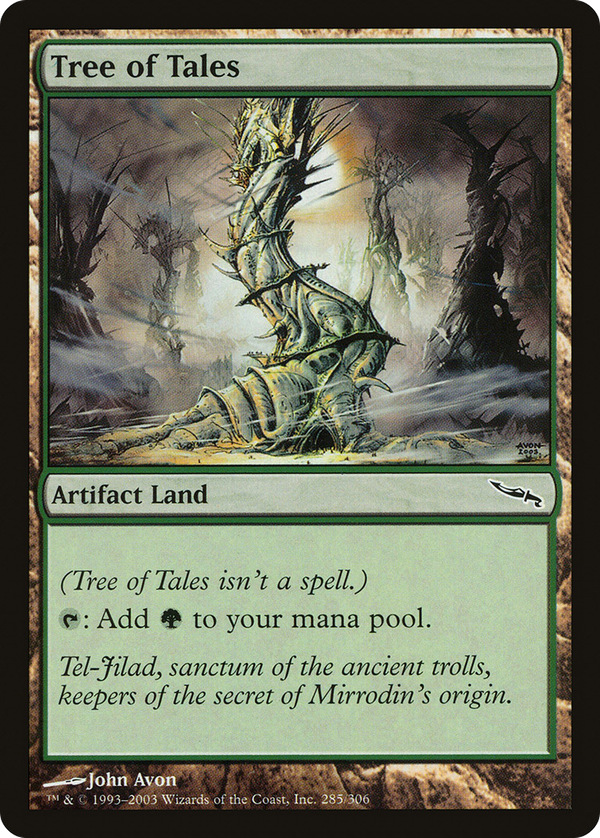
Rules text
 : Add
: Add  .
.