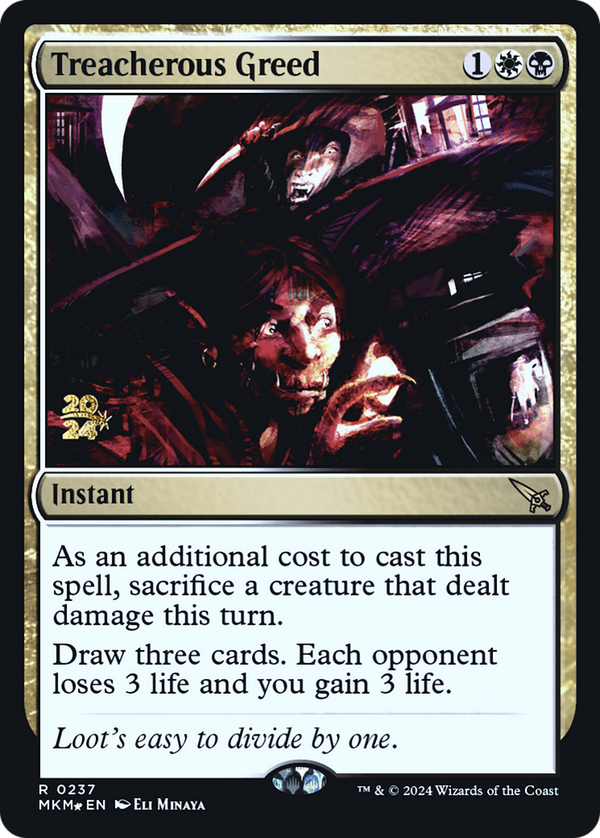
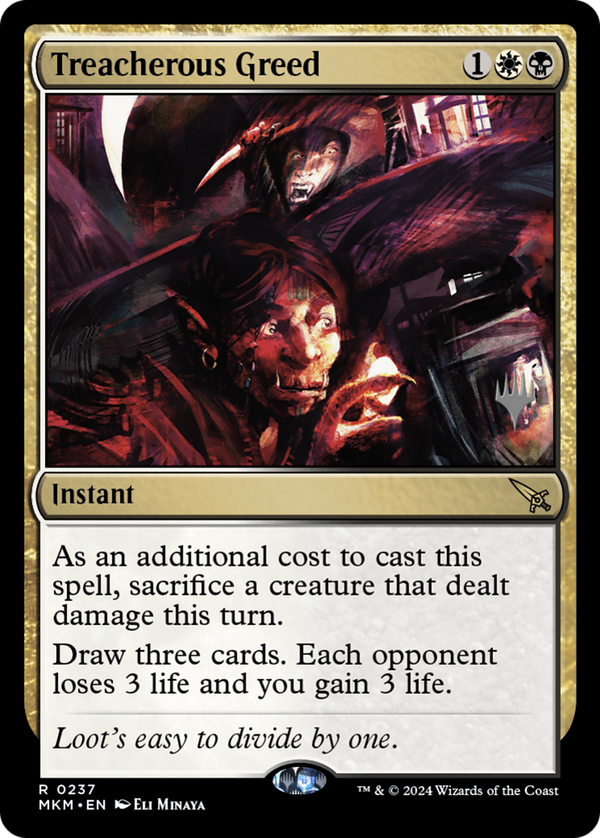
Treacherous Greed



The additional cost carries the whole balancing act. Drawing three, draining three, gaining three at this rate would be flatly overpowered without a real price, and the payment supplies it: not a creature that died, but a creature that dealt damage. That "dealt damage this turn" gate is the wrinkle, and it separates this from the usual aristocrat payoff. Most sacrifice effects care only that a body hit the graveyard; here the body has to have landed a blow first. The blow does not have to come from an attack: a blocker with power still deals its damage, and anything that pings, burns, or fights an opponent's board also qualifies, so the pool of legal fodder is wider than "your attacker" but narrower than "any creature." What it excludes is the inert body: the wall that trades without dealing damage, the token parked purely to feed an altar, the creature that dies as a state-based action in combat (where players never get priority, so there is no window to sacrifice it anyway). Instant speed is load-bearing here. It lets the payment wait until after combat damage is on the board, so a creature that fought can then convert into cards and life on the way out, and it lets you respond to removal by cashing a creature that has already dealt its damage rather than letting it die for nothing. The effect steers toward decks that make their creatures do work before they sacrifice them, and that demand on the fodder is what keeps the raw numbers from being oppressive.