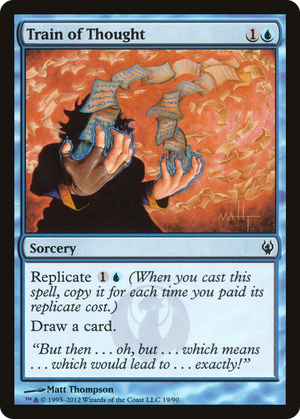
Train of Thought


Replicate exists to make a single spell scale with however much mana you have left over, and here it is bolted onto the most fungible effect in the game: draw a card. The result is a sorcery-speed reservoir of cards-per-mana that empties exactly as far as your hand can pay for. The math is plain: the base cost buys one card, and each replicate payment buys another, so a full tapout late in a stalled game converts your entire pool into a fistful of fresh cards in one cast. That tunability is the whole pitch. Where a fixed-size draw spell forces you to overpay early or underdraw late, this one lets you spend precisely what you have without holding a dead card or leaving mana idle. The cost is that it does nothing else: no card selection, no tempo, no board impact, just raw quantity at the speed a sorcery allows. It is refueling, and refueling only, which is why the design has always lived in slower decks that win on attrition rather than tempo. The replicate keyword tends to read as a curiosity attached to combat tricks and burn, but stapled to the cleanest effect a blue card can have, it becomes the purest test of what scalable card advantage is worth when you strip away every other consideration.
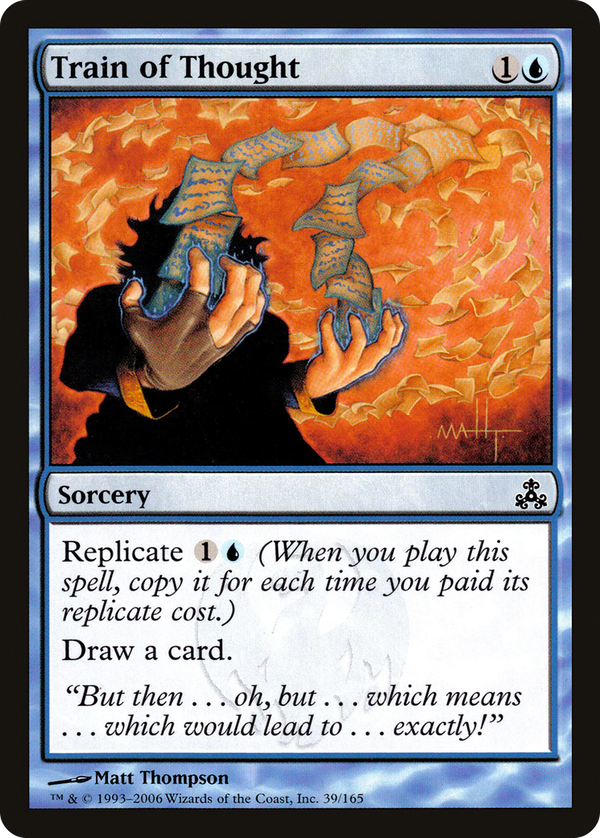
Rules text
(When you cast this spell, copy it for each time you paid its replicate cost.)
Draw a card.