Trail of Crumbs


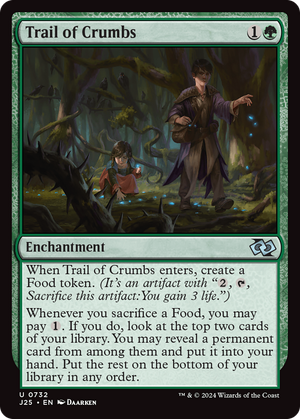
The clever pivot here is turning a lifegain artifact into a card-advantage engine. A Food token, as printed, is a slow instrument: pay two, tap, sacrifice, gain three, a rate no serious deck wanted for its own sake. This converts every one of those sacrifices into a filtered dig, taxing you one mana per trigger and letting you keep only a permanent card. That restriction is the discipline that keeps the rate fair: it does not dig for burn or counterspells, so it rewards a board stuffed with lands, creatures, and artifacts to hit reliably. The real reach comes from indifference to the source. It does not care what baked the Food or why it dies; any outlet that eats a Food fires the trigger, so the enchantment sits at the center of a value loop with anything that both cooks and consumes. Cauldron Familiar is the canonical partner: a cat that sacrifices a Food to return itself and ping an opponent for a life on the way back, and every recursion feeds the enchantment another look. Left alone it makes a single Food and asks you to find more; surrounded by consistent Food churn, it becomes a grindy selection machine, with the incremental life-drain coming from the partners doing the sacrificing, not from the enchantment itself. It represents the point where a token subtheme built for flavor and incidental lifegain graduated into a genuine engine payoff: the piece that made assembling a cooking shell worth doing on purpose, rather than a theme you merely supported in passing.
Rules text
 ,
,  , Sacrifice this token: You gain 3 life.")
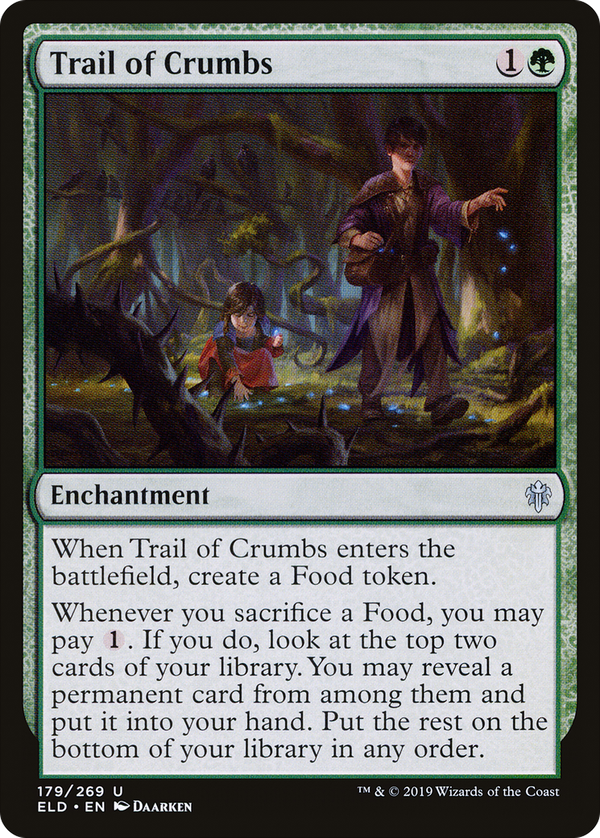
Whenever you sacrifice a Food, you may pay . If you do, look at the top two cards of your library. You may reveal a permanent card from among them and put it into your hand. Put the rest on the bottom of your library in any order.
, Sacrifice this token: You gain 3 life.")
Whenever you sacrifice a Food, you may pay . If you do, look at the top two cards of your library. You may reveal a permanent card from among them and put it into your hand. Put the rest on the bottom of your library in any order.