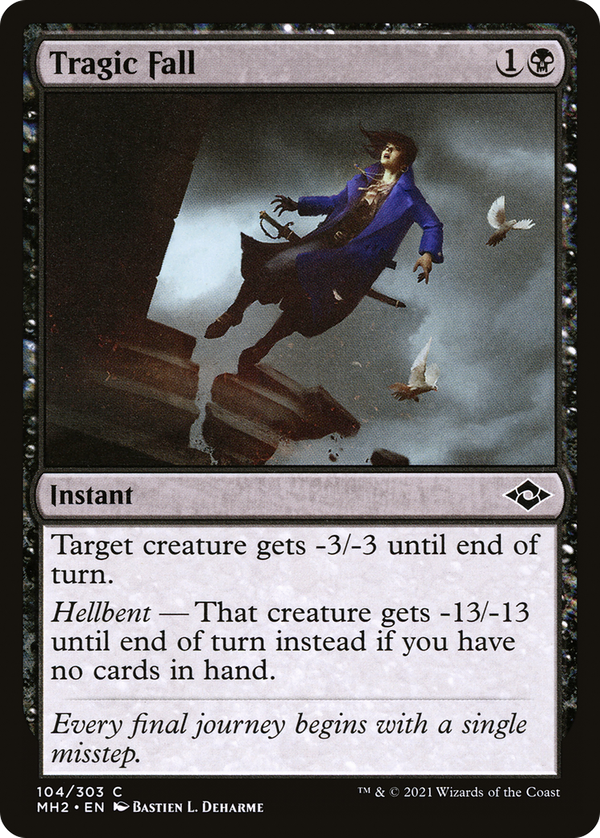
Tragic Fall


The number gap is the whole payoff structure. A -3/-3 instant at two mana is a fair, unremarkable rate: it kills most early creatures and trades down against anything with real toughness. But empty your hand and the same spell swings to -13/-13, a figure chosen to swallow essentially any creature that will ever resolve, including the fat finishers that laugh off ordinary removal. Hellbent has always been black's boom-or-bust reward, tuning a card's ceiling to how empty your hand is rather than how much mana you spend, and the mechanic asks a specific kind of deck to earn the upgrade: aggressive builds that dump their hand fast, or discard-and-madness shells that treat an empty hand as their natural resting state rather than a crisis. The design tension lives in that gap between the two modes. Cast it with cards in hand and you have a slightly overpriced kill spell; cast it hellbent and you have a two-mana answer to almost anything in the game, at instant speed, holding up the option to respond to a swing or a flash threat. That instant-speed window matters most to the empty-hand player: rather than committing on their own turn, they can leave it up as a live reactive line, turning the drawback of a spent hand into a threat that sits on the stack.