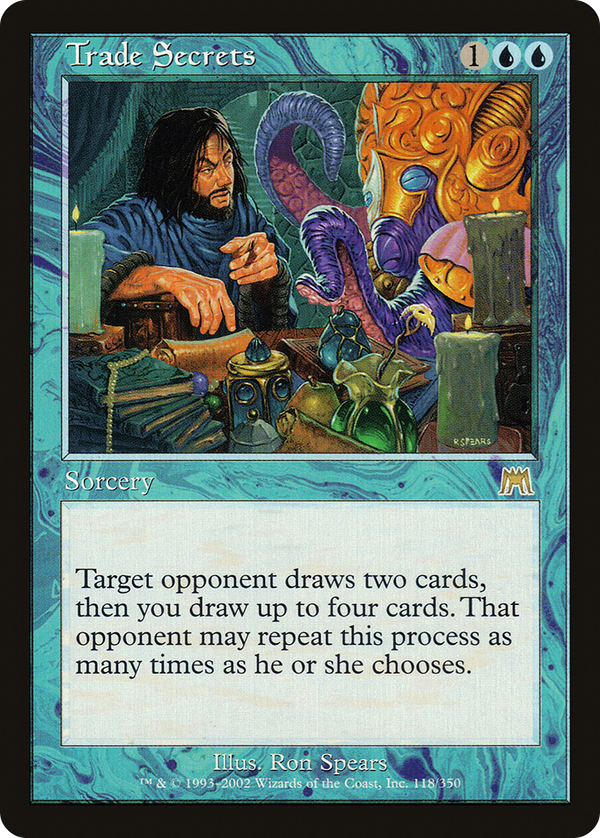
Trade Secrets


A symmetrical-looking deal that is anything but: the opponent draws two, you draw up to four, and then they decide whether to run it back. The first iteration is mandatory, so the spell never strands you with nothing; what it strands you with is the absurdity of asking a rational opponent to keep feeding you a four-for-two engine, one they will obviously decline after the opening trade. That refusal is the whole design conceit. The repetition clause is a genuine "may," and Magic offers no clean way to wrench a "yes" out of an unwilling opponent on a resolving spell, which is precisely why the card has never found a fair-play home. Its real notoriety lives in multiplayer politics, where an opponent decides the shared upside is worth their own two-card cost: a table-talk arrangement where someone agrees to press the button because the deal favors a position you both want, or a kingmaking moment late in a game where a player who has already lost would rather hand you a winning hand than help a rival. The engine is real (four per pass against their two), but it only ever turns on through consent, not compulsion. That makes this a clean example of a card whose power lives entirely outside its own text, locked behind a social agreement you have to broker rather than a piece you can supply yourself. Outside a cooperating table, it sits there as a bluff: a trap baited at someone who has every reason to walk away.