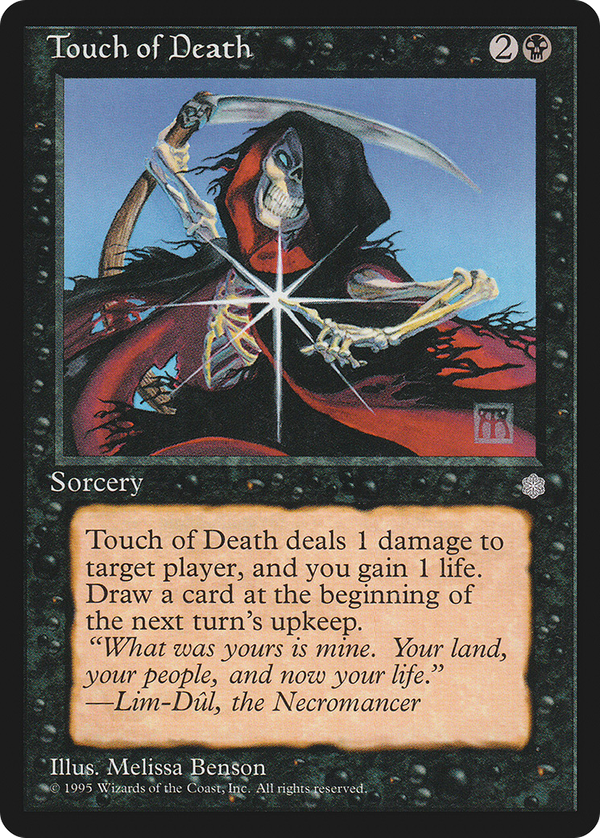
Touch of Death


Three things happen here, and none of them lands hard enough to matter: one point of damage to a player or planeswalker (never a creature, which rules it out as removal), one life back, and a card that arrives a full turn after you cast the spell. That delayed draw is what the whole effect hangs on, and also what undercuts it. By deferring the replacement to the next upkeep, the spell stops short of being a clean cantrip: you spend your mana, you wait, and the card only shows up the following turn. A sorcery that drained a point and immediately replaced itself would be a very different proposition; the lag is what keeps this one from getting there. With the damage restricted to players and planeswalkers, the package reads as a slow attrition piece: a point of reach, a point of lifegain, a card eventually. The arithmetic never quite resolves into a reason to play it, which is the honest read on a spell designed while the cost of a cantrip and the value of incidental drain were both still being calibrated. It survives as a marker of how much the baseline for cheap card advantage and burn-to-the-face has moved since.