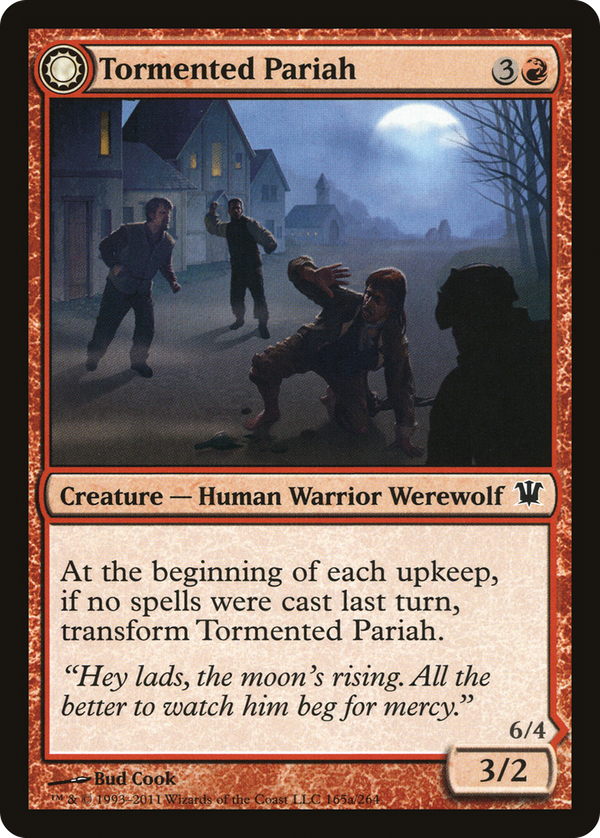
Tormented Pariah // Rampaging Werewolf
The flip condition reads the previous turn's casting log, not the current one, and that single design choice is what makes early double-faced Werewolves both elegant and maddening. A quiet turn (no spells cast by anyone) flips the modest human front face into the werewolf back side; a loud turn (any single player casting two or more spells) flips it back. The asymmetry is the social engine: your creature's strength is governed by a rhythm the whole table sets, not by your own discipline. An opponent who wants to keep your wolf from arriving needs only to cast a single spell each turn, breaking the silence the transform requires; the harder task is reversing it once it lands, which demands somebody fire off two spells in a turn. So the wolf side, once banked, tends to stick, because two-spell turns are rarer than one-spell turns. Because the trigger evaluates the upkeep against what already happened, the number of spells cast last turn is already fixed when it goes on the stack: you do not flip in reaction to a spell on the stack, you flip because of what last turn looked like, and you live with the result. As a body, the human side is a fragile 3/2 beater and the wolf side a payoff contingent on cooperation you cannot guarantee. That tension, a creature whose form is dictated by the table's collective tempo rather than any one player's choices, is exactly what this style of werewolf design was built to dramatize.