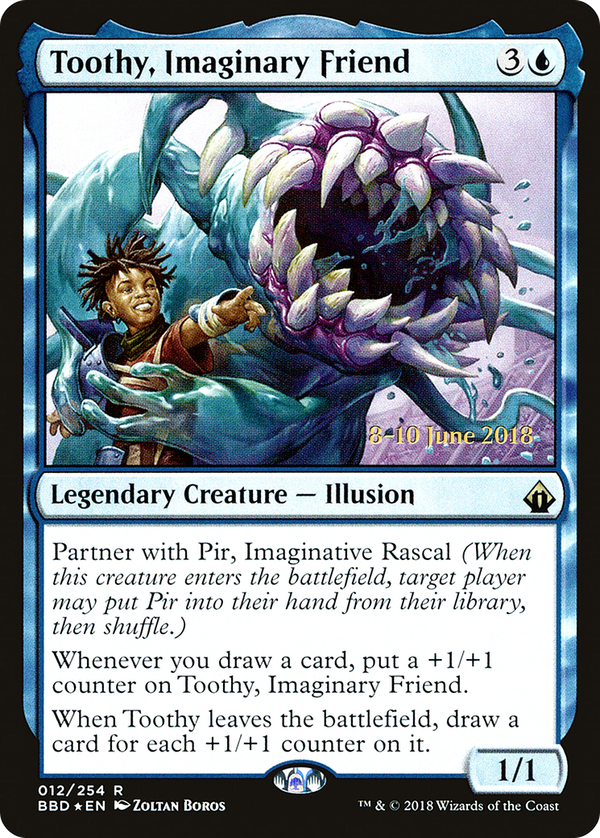
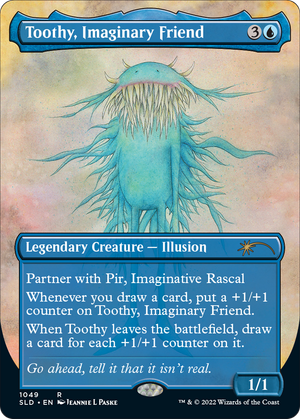
Toothy, Imaginary Friend


The trick that makes this body worth building around is that it pays you twice for the same draws: once on the way up, once on the way out. Each card you draw stacks a counter, so a 1/1 that nobody respects quietly becomes a clock while you do nothing but play your normal game. Then the back half flips the whole thing into a payoff engine: the counters convert to cards not when the creature dies but whenever it leaves the battlefield, and that distinction is the whole design. In blue especially, "leaves the battlefield" is a much wider door than "dies": a bounce spell, a blink, an exile answer, even your own recursion or flicker all cash out the counters just as reliably as a removal spell would. The opponent's clean answer becomes your card draw, and so does your own protective bounce. The counters are not a combat stat the table gets to deal with on their terms; they are stored card advantage collected on almost any exit, forced or voluntary. The partner clause with Pir, Imaginative Rascal is the obvious upgrade, since Pir's counter-doubling turns each draw into two counters and each cash-out into double the refill, but the engine stands on its own legs. What it rewards is the most ordinary thing a blue deck already does: drawing cards. The counters are the receipt. The exit is when you spend it.