Tooth and Claw


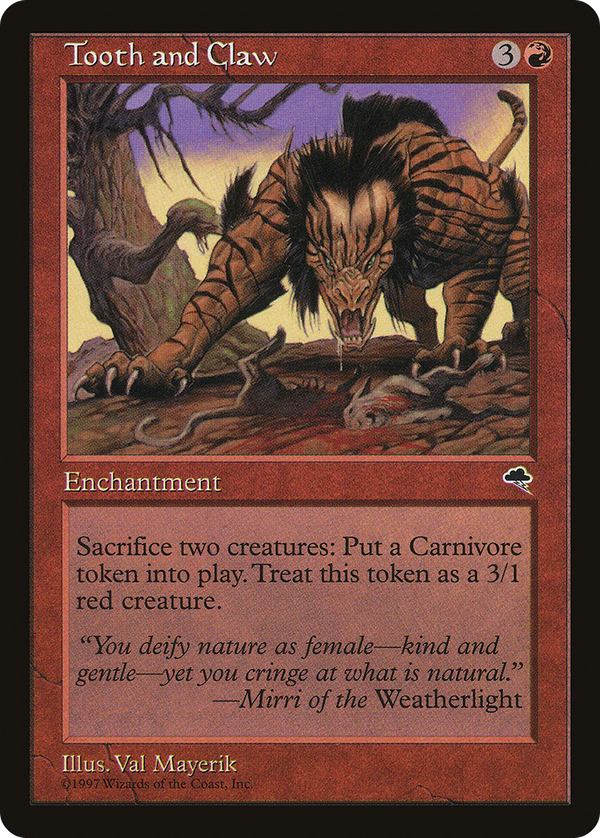
The activation costs no mana, only bodies: sacrifice two creatures, get back one fragile 3/1. That makes it a free sacrifice outlet by the modern definition, but a punishing one, because the conversion rate is two-for-one in the wrong direction. The math rarely flatters it; you spend two creatures to manufacture a worse single body, which usually reads as a bad trade and usually is one. The point is that the conversion is permanent and repeatable rather than a one-shot, so the value lives entirely in what feeds it. Tokens, creatures with death triggers, recurring bodies you would happily sacrifice anyway: anything that softens the two-for-one turns the ability from a tax into an outlet. That framing is what dates the card. It comes from an early sensibility where designers were still attaching free sacrifice effects to enchantments as standalone toys, before the outlet idiom matured into engines that gave you something worth the bodies you fed them. The named token, Carnivore, is a flavor flourish from the same era, when single tokens often carried their own identity rather than being interchangeable counters. The design reads now as an experiment in a direction the game refined past: the instinct to make a sacrifice outlet cost real resources was sound, but the payoff it settled on, a 3/1 for two creatures, never found the supporting cast to make the trade worth repeating.