Tonic Peddler


Three life in exchange for a white pip, a turn's tap, and a discarded card is the activated, repeatable echo of a cheap one-shot lifegain spell, and that repeatable framing is the whole pitch: rather than resolving once and leaving your hand, this stays on the battlefield and offers the effect again every turn, asking only that you keep feeding it. Because nothing restricts when the ability fires, it can blunt a burn spell or fix combat math on an opponent's turn, and that instant-speed flexibility does most of the work justifying the otherwise grim exchange. It rarely does enough. Converting cards into life pays off only when your hand is overflowing and your life total is the genuinely scarce resource, and those two states almost never coincide. The 1/1 body makes it worse: any deck banking on repeated activations has to protect a creature that dies to nearly every removal spell printed. What the design illustrates cleanly is the cost-substitution logic the Spellshaper class ran on, treating cards in hand as a renewable fuel source the way later mechanics would lean on the graveyard or on stored counters. The class wanted players to read their hand as ammunition rather than as a stack of threats to deploy; most decks, then and since, would simply rather hold the card and cast it.
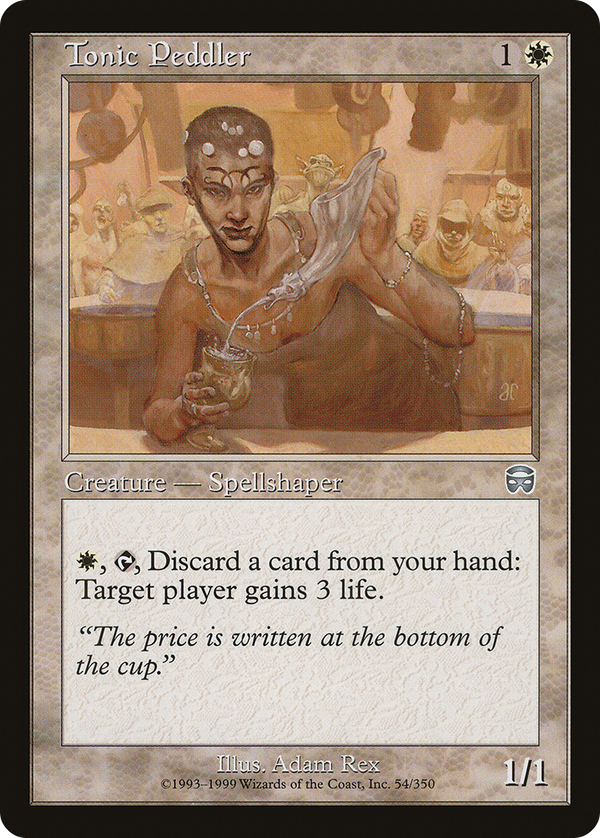
Rules text
,  , Discard a card: Target player gains 3 life.