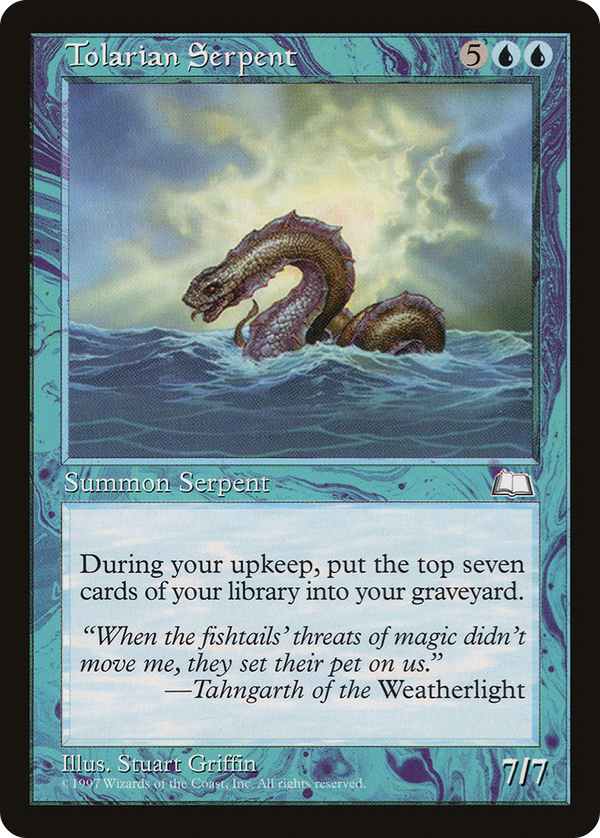
Tolarian Serpent


Mill, here, is not a weapon pointed across the table: it is the price of admission, charged to the creature's own controller. The 7/7 body and seven-mana cost are unremarkable for the era, but the upkeep trigger inverts an effect that other cards aim at an opponent and turns it inward, so the Serpent runs two clocks at once. One is the twenty-life clock it imposes with a fat body. The other is the decking clock it imposes on you, seven cards stripped from your own library every turn you keep it. The arithmetic is the wager. Seven power needs roughly three swings to close a game, which is three upkeeps and twenty-one cards gone, plus your draws, plus everything you spent getting it onto the battlefield. Commit to it and you have bet that it ends the game before it ends you; there is no middle outcome where it sits safely on the board. That precariousness is deliberate, and it makes the rate read as fair on paper while playing as a countdown in practice. Among the straightforward beaters of its time, this was an early attempt to price a finisher partly through a symmetrical-looking keyword turned against its owner, charging the controller in cards for access to a body rather than through the more familiar levers of weak stats or a steep cost.